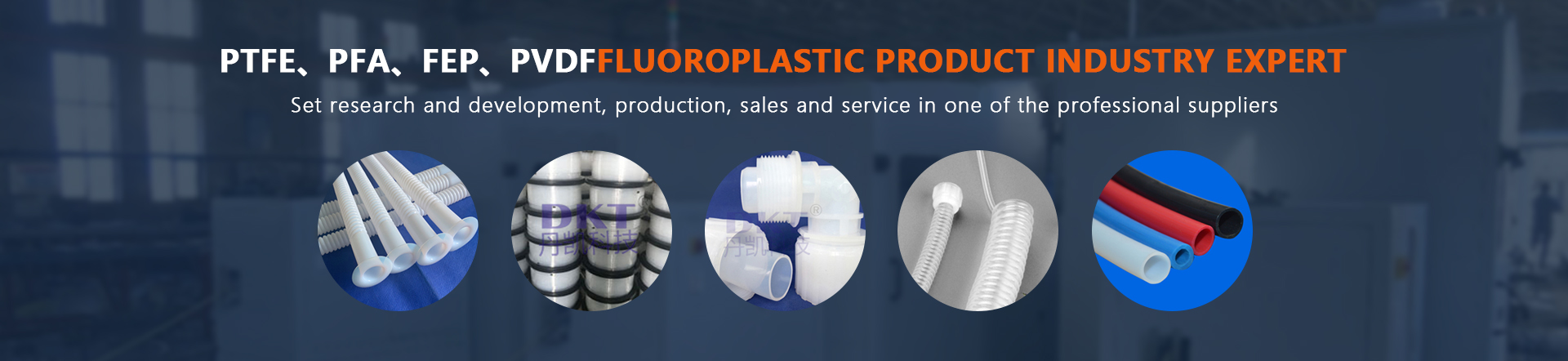
PTFE, PFA, FEP, PVDF Fluoroplastic products industry experts

Customer Witness
What factors influence the coefficient of thermal expansion of PFA tubing? What are the key considerations for applying the coefficient of thermal expansion of PFA tubing?
I. Introduction to the Coefficient of Thermal Expansion of PFA Tubing
PFA tubing is manufactured from PFA resin. The coefficient of thermal expansion of PFA (melt-processable polytetrafluoroethylene) tubing is one of the key performance parameters that underpin its use as a high-temperature, high-precision engineering material, directly influencing the dimensional stability and operational reliability of piping systems under temperature fluctuations.
II. Key Factors Influencing the Coefficient of Thermal Expansion of PFA Tubing
1. Material grade differences:
General-grade PFA: coefficient of thermal expansion approximately 150–200 × 10⁻⁶/°C (taking DuPont’s Chemours Teflon™ PFA series as an example; in practice, there are still some minor variations among different grades of PFA).
Modified/high-purity grades: Semiconductor-grade or glass-fiber-reinforced PFA can achieve a reduced coefficient of thermal expansion through formulation adjustments.
Test standards and methods: According to standards such as ASTM D696, the temperature range (e.g., 20–100°C) and the sample preparation method can influence the test results.
2. Application Scenario Adaptation:
High-temperature environments: Consider long-term dimensional stability under high temperatures to prevent pipe deformation or weld cracking caused by thermal stress.
Low-temperature environments: At extremely low temperatures, such as those achieved with liquid nitrogen, PFA exhibits a lower risk of cold embrittlement compared with metals; however, it is necessary to verify that its coefficient of thermal expansion at low temperatures meets the design requirements.

III. Thermal Expansion Coefficient of PFA Tubing Compared with Metals
The coefficient of thermal expansion of PFA tubing is approximately ten times that of carbon steel (~1.2 × 10⁻⁵/°C) and seven to nine times that of stainless steel (~1.7 × 10⁻⁵/°C). This means that, under the same temperature changes, PFA tubing will experience much greater dimensional changes than metal piping.
IV. Reference for the Practical Application of the Coefficient of Thermal Expansion of PFA Tubing
Thermal expansion calculation: A 1-meter-long PFA tube heated from 20°C to 100°C will elongate by approximately 10.4 mm (calculated using a coefficient of thermal expansion of 130 × 10⁻⁶/°C).
Installation highlights:
Operating conditions with large temperature fluctuations require provision for expansion compensation.
Avoid rigid connections with metal; it is recommended to use PFA-specific fittings to accommodate deformation.
For high-temperature applications (>150°C), low-expansion modified PFA material is available.
V. Recommendations for the Engineering Application of PFA Tubing
When selecting PFA tubing from a reputable manufacturer such as Dankai based on the construction process of an engineering project, the following points should be taken into consideration:
Design for Expansion: For long-distance straight-line installations, the expansion amount must be calculated based on pipe length, temperature difference, and the coefficient of thermal expansion, and an expansion joint or a flexible connection (such as a bellows or metal hose) must be provided to accommodate thermal expansion.
Material selection verification: For specific operating conditions—such as high temperature, severe corrosion, or high-frequency vibration—prioritize using the manufacturer’s grade-specific technical data sheets, while balancing cost and performance (PFA costs are approximately 10–20 times those of PP).
Installation process optimization: To prevent thermal stress concentration caused by rigid fixation, it is recommended to use compensating structures such as floating supports and expansion joints.
DANKAI is a nationally recognized High-Tech and Specialized, Sophisticated, and Novel enterprise. As an industry expert in PTFE, PFA, FEP, and PVDF fluoropolymer products, DANKAI is a comprehensive professional supplier integrating R&D, manufacturing, sales, and service.
Key words:
Previous Page
Dankai Technology
Address: Area B, 4th Floor, Building 1, North Yongfa Science and Technology Park, Yanchuan North, Chaoyang Road, Songgang Town, Bao'an District, Shenzhen, China
Tel: +86-755-29979617 23127719 23127819
E-mail: dkt@szdankai.com

Focus on us
Copyright©2024 All rights reserved of Shenzhen Dankai Technology Co., Ltd.