PTFE, PFA, FEP, PVDF Fluoroplastic products industry experts

What is PFA? Properties and applications of PFA
Classification:
Industry dynamics
News
Author:
PFA pipe lady
Source:
Dan Kai
Release time:
2021-11-05
Visits:
PFA is a relatively new fluoroplastic in China. Although its processing conditions are quite stringent, it boasts outstanding performance and is primarily used in the chemical industry—where high temperature and corrosion resistance are critical—as well as in the fluoroplastic wire and cable sector.
PFA, a type of Teflon fluoropolymer, is a copolymer of tetrafluoroethylene and perfluoroalkoxy vinyl ether. It is also known as soluble polytetrafluoroethylene or perfluoroalkoxy resin. Now, Ms. Dan Kai from the Teflon tubing division will walk you through the specific properties and applications of PFA:
I. What is Teflon PFA?
PFA resin is a relatively new melt-processable fluoropolymer.
PFA has a melting point of approximately 580°F and a density of 2.13–2.16 g/cm³. Like PTFE and FEP, PFA exhibits similar properties; however, above 302°C, its mechanical performance is slightly superior to that of FEP, and it can be used at temperatures as high as 500°F. Its chemical resistance is comparable to that of PTFE. PFA is available in granular form for molding and extrusion, as well as in powder form for rotational molding and coating applications; semi-finished products include films, sheets, rods, and tubes. On the U.S. market, PFA resins are marketed under brands such as DuPont’s Teflon, Daikin’s Neoflon, Ansimont’s Hthen, and Hoechst Celanese’s Hostafl. These grades can be customized according to customer-specified resin formulations. The applications of PFA are similar to those of FEP.
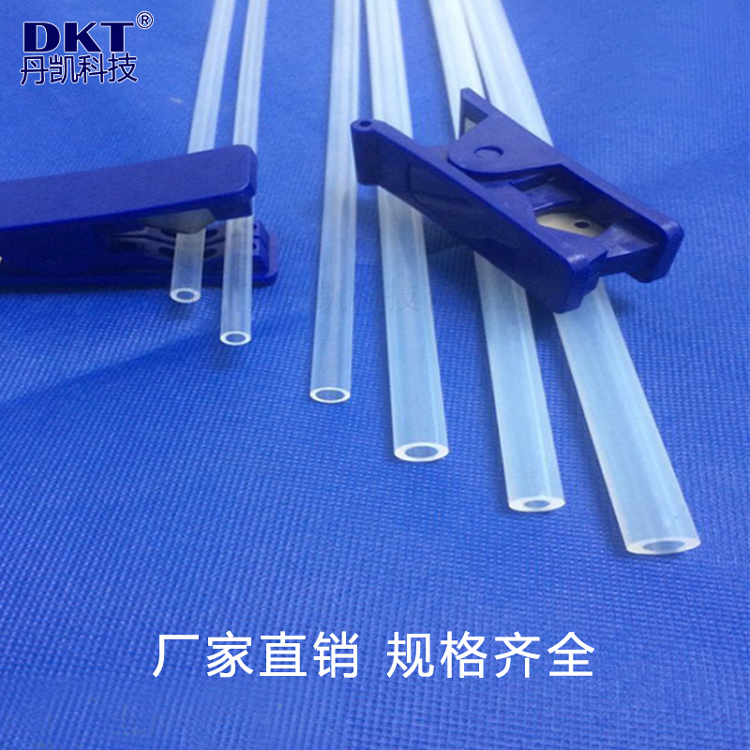
II. PFA Properties:
1. A copolymer of a small amount of perfluoropropyl perfluoro(vinyl ether) and polytetrafluoroethylene. It exhibits enhanced melt adhesion and reduced melt viscosity, while its performance remains unchanged compared with polytetrafluoroethylene. This resin can be directly processed into finished products using conventional thermoplastic molding methods.
2. It can withstand long-term use at temperatures ranging from -80°C to 260°C, exhibits outstanding chemical resistance—being resistant to all chemicals—and boasts the lowest coefficient of friction among plastics. It also offers excellent electrical properties, with its dielectric strength remaining unaffected by temperature. Known as the “King of Plastics,” it meets the V0 flame-retardant rating.
3. Its chemical resistance is similar to that of polytetrafluoroethylene and superior to that of vinylidene fluoride.
4. It exhibits superior creep resistance and compressive strength compared with polytetrafluoroethylene, along with high tensile strength and an elongation at break of 100–300%. Danke also boasts excellent dielectric properties and outstanding radiation resistance, as well as significant flame retardancy.
5. Non-toxic: Exhibits physiological inertness and is suitable for implantation in the human body.
III. Applications of PFA:
1. Suitable for manufacturing corrosion-resistant components, wear-reducing and wear-resistant parts, seals, insulating components, and medical device parts.
2. High-temperature wire and cable insulation, anti-corrosion equipment, sealing materials, pump and valve liners, and chemical containers.
Molding Performance: 1. Crystalline material with low hygroscopicity. It can be processed into finished products using conventional thermoplastic processing methods.
3. Poor flowability and high susceptibility to thermal decomposition, with corrosive gases being generated during decomposition. It is advisable to strictly control the molding temperature to no more than 475°C, preheat the mold to 150–200°C, and design the gating system to minimize flow resistance.
4. Semi-transparent granules, suitable for injection molding and extrusion. Molding temperature: 350–400°C; temperatures above 475°C may cause discoloration or bubble formation. Note also that demolding can be more difficult.
5. Since the molten material is corrosive to metals, the mold requires chrome plating after prolonged production.
PFA, FEP, and PTFE exhibit similar chemical properties; however, DanKai FEP can only be used below 200°C, while PTFE cannot be injection-molded.
As such, PFA is a relatively new fluoroplastic in China. Although its processing conditions are quite stringent, it boasts outstanding performance and is primarily used in the chemical industry—where high temperature and corrosion resistance are critical—as well as in the fluoroplastic wire and cable sector.
Shenzhen Dankai Technology Co., Ltd. is an intelligent manufacturing enterprise specializing in the R&D, production, sales, and service of fluoroplastic products—including FEP, PFA, PTFE, and PVDF pipes, rods, sheets, and films—as well as other insulating materials.
Shenzhen DanKai Technology Co., Ltd. is an intelligent manufacturing enterprise specializing in the R&D, production, sales, and service of FEP, PFA, PTFE, PVDF, and other fluoroplastic tube, bar, sheet, and film products, as well as other insulating materials.
The company boasts a senior R&D team that adheres to international standards and an imported fluoroplastic production line. Certain fluoroplastic products have obtained ISO 9001, SGS, and FDA certifications.
Our main product lines include: ① Tubing: PTFE (polytetrafluoroethylene) tubing, FEP tubing, PFA tubing, and PVDF tubing; ② Heat-shrink tubing: PTFE heat-shrink tubing, FEP heat-shrink tubing, PFA heat-shrink tubing, and PVDF heat-shrink tubing; ③ Sheets, rods, and films: PTFE sheets, rods, and films, FEP sheets, rods, and films, PFA sheets, rods, and films, and PVDF sheets, rods, and films; ④ Insulating materials: silicone, PE, PVC, UPE, and others; ⑤ Specialty products: imported PFA fittings, spiral tubing, spring tubing, rotary-cut tubing, welding rods, tees, straight connectors, gaskets, couplings, tapered rods, flared tubing, sealing tubes, braided tubing, corrugated tubing, and more. In addition, we offer custom manufacturing and processing of fluoroplastic products in a wide range of specifications to meet specific customer requirements.
This article is originally written by the Teflon Tube Lady. Follow us to learn something new together!
Key words:
PFA, FEP, PTFE, fluoroplastics, properties, processing, polytetrafluoroethylene, company, comparison
Previous Page
Previous Page


Dankai Technology
Address: Area B, 4th Floor, Building 1, North Yongfa Science and Technology Park, Yanchuan North, Chaoyang Road, Songgang Town, Bao'an District, Shenzhen, China
Tel: +86-755-29979617 23127719 23127819
E-mail: dkt@szdankai.com

Focus on us
Copyright©2024 All rights reserved of Shenzhen Dankai Technology Co., Ltd.