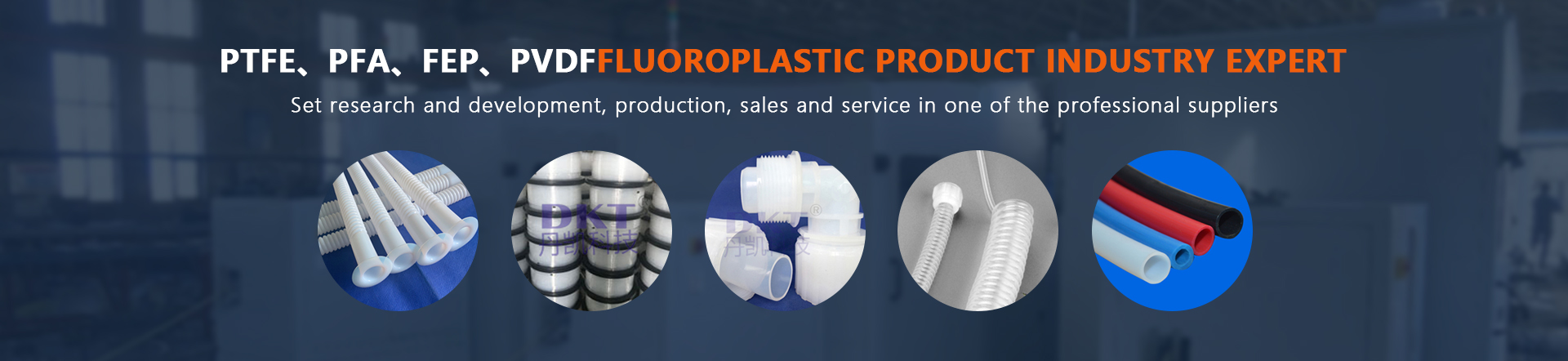
PTFE, PFA, FEP, PVDF Fluoroplastic products industry experts

Customer Witness
What are the performance differences between PFA tubing and FEP tubing, and how should one select between the two?
I. Introduction to PFA Tubing and FEP Tubing
Both PFA tubing and FEP tubing are fluoropolymer tubing products, representing improved variants of PTFE (polytetrafluoroethylene, commonly known as “Teflon”). They exhibit outstanding properties such as exceptional corrosion resistance, high-temperature resistance, and low friction.
II. Performance Comparison Between PFA Tubing and FEP Tubing
PFA tubing is essentially an “upgraded version of FEP for high-temperature, high-purity, and demanding applications,” offering higher temperature resistance, superior mechanical strength, and enhanced resistance to stress cracking—though at a higher cost. FEP tubing, on the other hand, is a “cost-effective, transparent fluoroplastic tubing” with slightly lower temperature resistance, a more affordable price, and easier machinability, making it well suited for most medium- and low-temperature corrosive service conditions. The following sections will explain these distinctions in detail.
1. Materials and Name Explanation
PFA: Perfluoroalkoxy, a melt-processable polytetrafluoroethylene, is a perfluoropolymer.
FEP: Fluorinated Ethylene Propylene, also known as polyfluoroethylene propylene, is a fully fluorinated polymer and a modified copolymer of PTFE.
Both belong to the “fluoroplastic/Teflon family” and share the following common characteristics: corrosion resistance, resistance to both high and low temperatures, electrical insulation, non-stick properties, and low surface energy.

2. Key Performance Comparison
2.1 Operating Temperature
PFA tubing has a long-term service temperature range of approximately –80°C to +260°C, with short-term peak temperatures that can approach 300°C.
FEP tubing is rated for temperatures ranging from approximately -80°C to +200°C, with short-term peak temperatures generally not exceeding 200–220°C.
2.2 Chemical Corrosion Resistance
Both are fluoroplastics that exhibit “near-ultimate corrosion resistance,” remaining highly stable in the presence of most acids, bases, solvents, and oxidizing agents.
PFA exhibits overall chemical inertness that is closer to that of PTFE, with slightly superior corrosion resistance under high-temperature and highly corrosive conditions compared with FEP.
2.3 Mechanical Strength & Stress Crack Resistance
At elevated temperatures (below 150°C), PFA exhibits significantly superior tensile strength and creep resistance compared with FEP.
PFA exhibits significantly superior resistance to stress cracking compared with FEP, making it more reliable under conditions of repeated bending, vibration, and cyclic temperature changes.
2.4 Transparency and Appearance
FEP tubing: highly transparent, among the most transparent of all fluoroplastics, facilitating easy observation of the fluid flow inside the tube.
PFA tubing is typically semi-transparent or highly transparent, though its overall transparency is slightly lower than that of FEP; some grades exhibit a slight hazy appearance.
2.5 Machinability and Installation
Both are melt-processable fluoroplastics.
FEP has a slightly lower melting point and a wider processing temperature window, making extrusion and welding relatively easier and on-site installation more straightforward.
PFA exhibits higher melt viscosity, imposing stricter requirements on processing equipment and procedures, yet it offers superior high-temperature performance.
2.6 Price and Cost
In the market, FEP is generally more affordable than PFA and is classified as an “economy-grade fluoroplastic.”
Due to its more complex synthesis process and superior performance, PFA generally commands a higher price than FEP.
III. Typical Application Scenarios for PFA and FEP Tubing
3.1 Application Scenarios of PFA Tubing
Semiconductor manufacturing: Used for the delivery of high-purity chemicals, such as hydrofluoric acid, due to its extremely low metal-ion leaching and ability to withstand high-temperature processes.
High-temperature chemical processing: In reaction systems above 200°C, PFA maintains structural stability and does not soften or deform.
Precision analysis: Leveraging its high transparency and low adsorption properties, it is used as a sampling tube for trace analysis to ensure that samples remain uncontaminated.
3.2 Application Scenarios of FEP Tubing
Electrical insulation: Widely used in wire and cable sheaths, particularly in applications requiring excellent flexibility and high-frequency insulation performance.
Laboratory equipment: Used as condensers and infusion tubing due to their transparency, chemical resistance, and lower cost.
Heat-shrink materials: FEP heat-shrink tubing is commonly used for insulating and protecting welds in high-temperature environments, offering stable shrink performance.
IV. Selection Guide for PFA and FEP Tubing
Select based on temperature: for operating temperatures above 200°C, choose PFA; below
200℃ → FEP optional.
Select based on purity: for high purity (semiconductor, pharmaceutical) applications, choose PFA; for standard purity, FEP is a suitable option.
Choose based on cost: if your budget is ample and you prioritize performance, go with PFA; if you’re aiming to control costs for standard applications, opt for FEP.
Select according to observation requirements: if real-time fluid observation is required, choose FEP; if no observation is needed, PFA is an acceptable option.
DANKAI is a nationally recognized High-Tech and Specialized, Sophisticated, and Novel enterprise. As an industry expert in PTFE, PFA, FEP, and PVDF fluoropolymer products, DANKAI is a comprehensive professional supplier integrating R&D, manufacturing, sales, and service.
This article is originally written by the Teflon Tube Lady. Follow us to learn something new together!
Key words:
Next Page
Dankai Technology
Address: Area B, 4th Floor, Building 1, North Yongfa Science and Technology Park, Yanchuan North, Chaoyang Road, Songgang Town, Bao'an District, Shenzhen, China
Tel: +86-755-29979617 23127719 23127819
E-mail: dkt@szdankai.com

Focus on us
Copyright©2024 All rights reserved of Shenzhen Dankai Technology Co., Ltd.