PTFE, PFA, FEP, PVDF Fluoroplastic products industry experts

What are the characteristics of polytetrafluoroethylene (PTFE)
Classification:
Industry dynamics
Author:
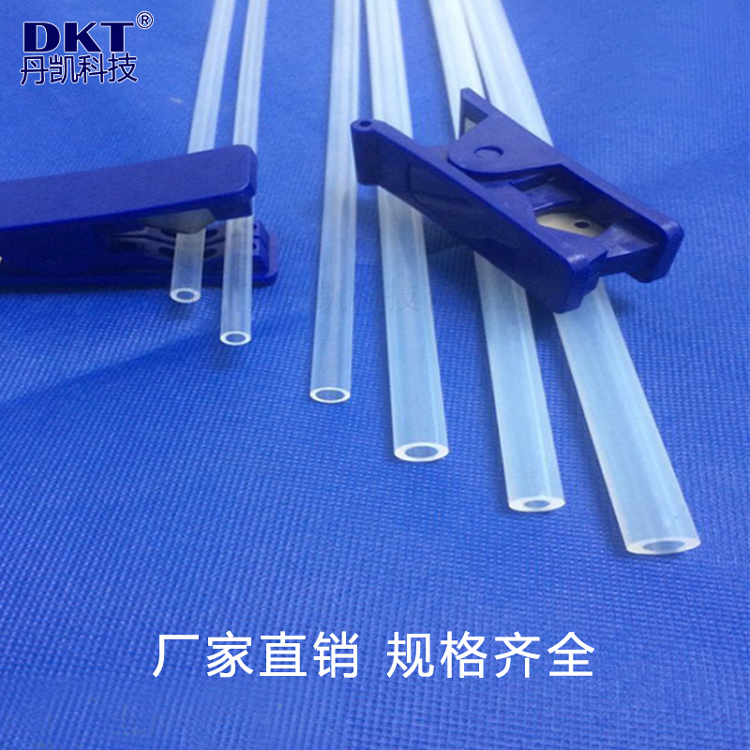
FEP tube little sister
Source:
Dankai
Release time:
2019-10-14
Visits:
What are the characteristics of polytetrafluoroethylene (PTFE)
Polytetrafluoroethylene, English name: Polytetrafluoroethylene, referred to as FTFE or F4. Polytetrafluoroethylene is a polymer of tetrafluoroethylene. Polytetrafluoroethylene (Teflon or PTFE), commonly known as "plastic king", was invented in 1938.
The F atom in PTFE molecule covers the C- C bond and the C- F bond energy is high and particularly stable. It is not attacked by any chemical except alkali metal and fluorine element.
The F atom in the PTFE molecule is symmetrical, the two elements in the C- F are covalently combined, there is no free electron in the molecule, and the whole molecule is neutral. PTFE has excellent dielectric properties. Because the PTFE molecule has a layer of inert fluorine-containing shell, it has outstanding non-stick properties and low friction coefficient.
PTFE has outstanding excellent comprehensive performance, high temperature resistance, corrosion resistance, non-stick, self-lubricating, excellent dielectric properties, very low coefficient of friction. The mechanical properties of PTFE can be greatly improved by adding any filler that can withstand the sintering temperature of PTFE. At the same time, other excellent properties of PTFE are maintained. Filled with varieties of glass fiber, metal, metal oxide, graphite, molybdenum disulfide, carbon fiber, polyimide, EKONOL, etc., wear resistance, limit PV value can be increased by 1000 times.
PTFE has excellent chemical stability, corrosion resistance, sealing, high lubrication non-stick, electrical insulation and good anti-aging resistance. Can work for a long time at a temperature of 250 ° C to -180 ° C. In addition to molten metal sodium and liquid fluorine, it can withstand all other chemicals and does not change when boiled in aqua regia.
PTFE engineering plastics can be made into PTFE tubes, rods, belts, plates, films, etc. It is generally used in corrosion-resistant pipes, containers, pumps, valves, radar, high-frequency communication equipment, radio equipment and so on. The dispersion liquid can be used as an insulating immersion liquid for various materials and an anti-corrosion layer on the surface of metal, glass and pottery. All kinds of PTFE ring, PTFE gasket, PTFE packing, etc. are widely used in all kinds of anti-corrosion pipeline flange sealing. In addition, it can also be used for spinning, PTFE fiber-Fluoron (foreign trade name is Teflon).
Key words:
Next Page
Next Page


Dankai Technology
Address: Area B, 4th Floor, Building 1, North Yongfa Science and Technology Park, Yanchuan North, Chaoyang Road, Songgang Town, Bao'an District, Shenzhen, China
Tel: +86-755-29979617 23127719 23127819
E-mail: dkt@szdankai.com

Focus on us
Copyright©2024 All rights reserved of Shenzhen Dankai Technology Co., Ltd.