PTFE, PFA, FEP, PVDF Fluoroplastic products industry experts

0911 A brief description of the commonness and individuality of PFA tubes, PFA rods, PFA membranes and PFA end plates.
Classification:
Industry dynamics
Author:
FEP tube little sister
Source:
FEP tube little sister
Release time:
2010-08-04
Visits:
Introduction to PFA:
1. PFA is a copolymer of a small amount of perfluoropropyl perfluorovinyl ether and polytetrafluoroethylene. The melt adhesion is enhanced, the solution viscosity is reduced, and the performance is unchanged compared with PTFE. This kind of resin can be directly processed into products by ordinary thermoplastic molding methods.
2, long-term use temperature -196-260 degrees, has excellent chemical resistance, corrosion resistance to all chemicals, the friction coefficient is the lowest in plastics, there are good electrical properties, its electrical insulation is not affected by temperature, known as "plastic king.
3, its chemical resistance is similar to polytetrafluoroethylene, better than vinylidene fluoride.
4, its creep resistance and compression strength are better than PTFE, high tensile strength, elongation up to 100-300%. Good dielectric properties, excellent radiation resistance, flame retardant V0 level.
5, non-toxic: with physiological inertia.
PFA material has tubes, rods, membranes, end plates, etc. The main functions of PFA rods: hydrolysis resistance, acid and alkali resistance, impact resistance, chemical resistance, wear resistance, high temperature resistance, insulation, anti-static, corrosion resistance.
PFA material has PFA tube, PFA rod, PFA membrane, PFA end plate and other uses:
Used for various anti-corrosion, sealing, anti-wear, insulation parts, anti-sticking, light transmission parts, capacitor insulation and corrosion-resistant water pump pump head, valves, accessories, seals, high temperature seals, corrosion-resistant parts are suitable for making corrosion-resistant parts, anti-wear parts, seals, insulation parts and medical equipment parts, etc.
PFA plastic is suitable for the production of corrosion-resistant parts, wear-reducing parts, seals, insulation and medical equipment parts, high-temperature wire, cable insulation, anti-corrosion equipment, sealing materials, pump valve bushings, and chemical containers.
The following detailed introduction of PFA material PFA tube, PFA rod, PFA membrane, PFA end plate.
1. PFA end plate
Fluoroplastic heat exchanger (below) is a heat exchanger with small diameter fluoroplastic hose as heat transfer component, also known as flexible tube heat exchanger. Commonly used fluoroplastics are polytetrafluoroethylene (F4), polyethylene (F46) and fusible polytetrafluoroethylene (PFA). Fluoroplastic heat exchangers are mainly used for heat exchange of various highly corrosive media with working pressure of 0.2~0.4MPa and working temperature below 200 ℃, such as sulfuric acid, highly corrosive chloride solution, acetic acid and caustic media. Cooling or heating.

Figure 1:PFA Endplate Source: Network
What do PFA end plates have to do with fluoroplastic heat exchangers? They are equivalent to the complementary relationship of oil and salt, which play their peak role with each other. As shown in the figure above, the honeycomb tube sheet is the end plate, and the fluoroplastic heat transfer hose needs to be inserted into the end plate. The end plate is fixed to the tube, so that the end plate has its use value.
It is clear that PFA is of high quality in fluoroplastics, and good horses are equipped with saddles. At present, the biggest use of PFA end plates is the fixing of heat exchangers.
2. PFA Stick
The main features of PFA bar:
1. The working temperature of PFA bar -196 to 260 degrees
2.2. Almost unlimited chemical resistance, alkali resistance, sulfuric acid resistance, corrosion resistance, aging resistance, and ultraviolet resistance
3. PFA (soluble polytetrafluoroethylene) has excellent heat resistance, cold resistance, chemical stability, mechanical properties, insulation, self-lubrication, folding resistance and cracking resistance.
4. Food grade PFA stick, non-toxic, special for medical machinery, special for food machinery

Figure 2:PFA Bar Source: Shenzhen Dankai
3. PFA board
The PFA sheet has a melting point of about 580F and a density of 2.13-2.16g/cc (grams per cubic centimeter). PFA is similar to PTFE and FEP, but above 302T, the mechanical properties are slightly better than FEP, and can be used at temperatures up to 500F, and its chemical resistance is equivalent to PTFE.
The product forms of PFA are used in the form of granular products for molding and extrusion, powder products for rotational molding and coating, and semi-finished products include films, plates, rods and pipes. The use of PFA is similar to FEP.

Figure 3:PFA Board Source: Shenzhen Dankai
PFA plate forming performance:
1, crystalline material, moisture absorption is small. Can be processed into products using the usual thermoplastic processing methods
2, poor fluidity, easy to decompose, decomposition of corrosive gas. It is advisable to strictly control the molding temperature not to exceed 475 degrees, the mold should be heated to 150-200 degrees, and the resistance of the gating system to the material flow should be small.
3. Translucent pellets, injection molding, extrusion molding. The molding temperature is 350-400 degrees, and more than 475 degrees is easy to cause discoloration or bubbles. And note that demoulding will be more difficult.
4, because the molten material has a corrosive effect on the metal, long-term production, the mold needs to be plated with chromium. The chemical properties of PFA FEP PTFE are similar, but FEP can only be used below 200 degrees, and PTFE cannot be injection molded.

Figure 4:PFA Board Source: Shenzhen Dankai
4. PFA tube
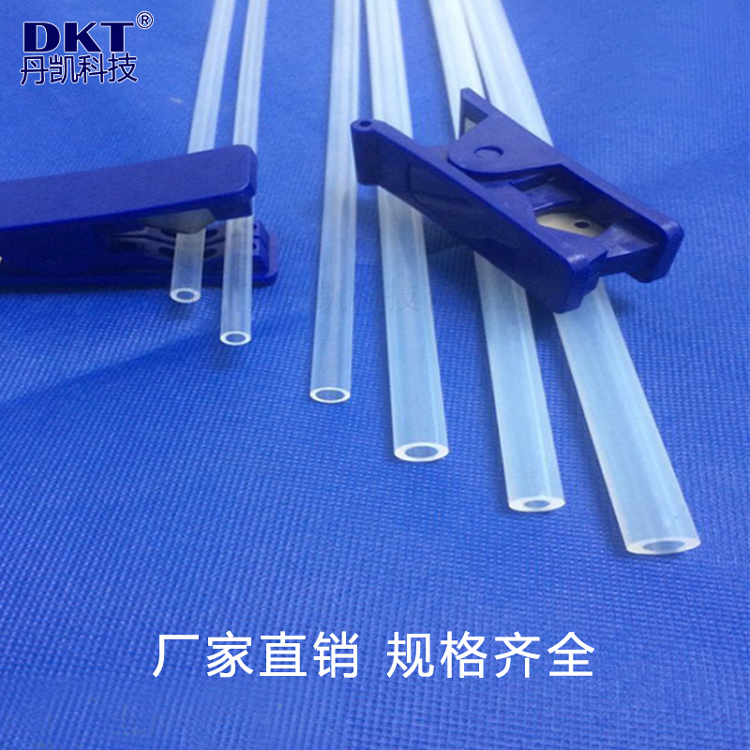
1. Name: Pfa tube, soluble polyethylene glycol propylene tube, transparent Teflon tube;
2. Pfa tube color: commonly used colors: transparent, black; Less commonly used colors: yellow, brown, green, blue and other colors can be customized
3. in stock are the common specifications of Pfa tubes:
Inner diameter * outer diameter (unit: mm) other specifications can be customized
Pfa tube metric system: 2*4 3*5 4*6 5*7 6*8 8*10 8*12 9*12 10*1212*14 14*16 16*18 18*20
Pfa tube inch system: 1/8 inch (1.6*3.2) 1/4 inch (3.96*6.35) 3/8 inch (6.35*9.525)
1/2 inch (9.5*12.7)3/4 inch (15.88*19.05) 1 inch (22.2*25.4)
Pfa pipe can be produced in specifications, with an inner diameter of 0.5mm to an inner diameter of 200mm and a wall thickness of 0.12mm to 3mm.
4. pfa pipe connection mode. Threaded connection; Flaring connection is to heat the pipe and then set it up.
5. PFA membrane
fusible pfa film, pfa film, polyethylene glycol propylene sheet, film is made of polyethylene glycol propylene resin by extrusion or blow molding method, mainly used for anti-corrosion, anti-sticking, breathable, light transmission parts, insulation of electronic and electrical appliances, composite plate interlayer, etc.
Main performance
1. Appearance: smooth, transparent and flat surface
2. Physical and mechanical properties
| Indicator Name |
Unit |
Indicators |
| Density |
g/cm3 |
2.14∽2.17 |
| Tensile Strength |
MPa |
≥14 |
| Elongation at break |
% |
≥175 |
| Right Angle Tear Strength |
MPa |
≥5 |
| volume resistivity |
Ω ·cm |
≥1×10¹⁶ |
Note: The tensile strength and elongation at break of the film with thickness ≤ 0.05mm are slightly lower than the indexes in the table.
Specifications
| Name | Width (mm) | Thickness (mm) |
| Extruded film, sheet | 50-300 | 0.05-1.5 |
| Name | Folding diameter (mm) | Thickness (mm) |
| blown film | 100 ∽ 600 | 0.03-0.25 |
Note: If the user needs other specifications of the film and sheet, can be customized according to the negotiation between the two parties.
Key words:
Previous Page
Previous Page


Dankai Technology
Address: Area B, 4th Floor, Building 1, North Yongfa Science and Technology Park, Yanchuan North, Chaoyang Road, Songgang Town, Bao'an District, Shenzhen, China
Tel: +86-755-29979617 23127719 23127819
E-mail: dkt@szdankai.com

Focus on us
Copyright©2024 All rights reserved of Shenzhen Dankai Technology Co., Ltd.