PTFE, PFA, FEP, PVDF Fluoroplastic products industry experts

Teflon heat exchanger
Classification:
Industry dynamics
Author:
Teflon tube little sister
Source:
Teflon tube little sister
Release time:
2007-07-07
Visits:
1. Teflon heat exchanger
Teflon is called Polytetrafluoroetylene in English, referred to as Teflon, PTFE, F4, etc. Because of the pronunciation, it is often called Teflon, Teflon, Teflon, Teflon, etc. (all transliterations of Teflon). Teflon has comprehensive advantages that other materials cannot compete, especially the application of temperature characteristics and corrosion resistance of Teflon materials in heat exchangers, so that Teflon heat exchangers have been widely used in corrosion-resistant industries, such as chemical industry, Pickling, electroplating, medicine, anodizing and other industries.
Teflon heat exchanger has superior corrosion resistance and aging resistance. Due to its excellent temperature resistance, it is suitable for steam heating and hot water heating;
Teflon heat exchanger is a new type of corrosion resistant heat exchanger developed in recent ten years. The main results are in the form of shell and tube and immersion. It has unparalleled chemical stability and thermal stability (-250~260 ℃). F4 heat exchanger tube sheet and tube bundle (φ3~10mm capillary) are sintered by advanced powder metallurgy process, with excellent performance. Through a unique and advanced welding method, the connection strength between the tube bundle and the tube sheet of the Teflon heat exchanger reaches 1.5 Mpa;
Teflon heat exchanger mainly has excellent corrosion resistance. Since Teflon is a chemically inert material, it can work in almost all media except elemental fluorine at high temperatures, molten alkali metals, chlorine trifluoride, uranium hexafluoride, and perfluorinated kerosene. Such as: concentrated hydrochloric acid, hydrofluoric acid, sulfuric acid, nitric acid, phosphoric acid, acetic acid, oxalic acid, caustic soda, sodium hypochlorite, naphthalene, benzene, xylene, acetone, aqua regia, chlorine, toluene, various organic solvents and so on;
Teflon heat exchanger has good scaling resistance. Due to the chemical inertness, surface smoothness, coiling and high expansion coefficient of the PTFE tube, the heat transfer surface is difficult to scale, which greatly reduces the number of equipment maintenance and ensures a relatively stable heat transfer coefficient and production. Long-term operation.

Figure 1: Teflon Heat Exchanger Source: Network
Teflon heat exchanger has good anti-aging performance. Since Teflon does not contain photosensitive genes, it has excellent resistance to atmospheric aging. Its service life is 20 to 30 times that of stainless steel in strong corrosive medium;
Teflon heat exchanger has good heat transfer performance. The heat exchanger uses thin-walled tubes with wall thicknesses of only 0.5mm, 0.75mm and 1mm, so the low thermal conductivity of Teflon material is overcome, and the total heat transfer coefficient can reach 150-300(W/M · K);
Teflon heat exchanger resistance is small. The friction coefficient of Teflon is very small, the roughness is low, and the lubrication performance is very good, so the resistance of the fluid in the tube bundle is smaller than that of the metal tube;
Teflon heat exchanger is small in size, light in weight and compact in structure.
Special Teflon pipe for 2. heat tracing sampling pipe
According to the actual conditions such as the composition and temperature of the sample gas, the sampling pipe in the corrosion-resistant heat-tracing sampling composite pipe can be made of different materials, such as PFA (tetrafluoroethylene and perfluoroalkyl ether copolymer), FEP (tetrafluoroethylene and hexafluoropropylene copolymer), Teflon tube PTFE (polytetrafluoroethylene) and PVDF (polyvinylidene fluoride). The heat tracing belt can be used for medium, low and high temperature heat tracing, and compensation wires and power lines can also be added.

Figure 2: Source of heat tracing sampling pipe: Shenzhen Dankai
The heat tracing sampling pipeline is a heat tracing method for flue gas pipelines in power plants, petrochemicals, natural gas, refined oil, crude oil and other industries, and is an important part of the environmental monitoring system.
Special Teflon (sleeve) pipe for heat tracing sampling pipe is a special pipe made of polytetrafluoroethylene (PTFE, commonly known as Teflon and plastic king) material after extrusion and sintering, and then made by drying, high temperature sintering, shaping and other processes.
Teflon is also called Teflon, Teflon, Teflon, Teflon, Teflon, Teflon, PTFE, Plastic King, English is Teflon, which is widely used in machinery, electronic appliances, automobiles, aerospace, chemicals, computers, Electric heating, military, communications and other important scientific and technological industries, such as micro transformers.
Special Teflon pipe performance for heat tracing sampling pipe:
1. Non-stick: Teflon is inert, almost all substances are not bonded to Teflon, and very thin films also show non-adhesive properties.
2. Cold and heat resistance: Teflon has excellent heat resistance and low temperature resistance. Short time temperature resistance to 300 ℃, melting point of 327 ℃,380 ℃ does not melt, the general work can be used continuously between 240 ℃ ~ 260 ℃, with significant thermal stability, it can work at freezing temperature without embrittlement, cold resistance to 190 ℃.
3, lubricity: Teflon has a lower coefficient of friction. The friction coefficient changes when the load slides, but the value is only between 0.04 and 0.15.
4. Non-hygroscopicity: Teflon surface is not stained with water and oil, and it is not easy to be stained with solution during production operation. If there is a small amount of dirt, it can be removed by simple wiping. Short downtime saves man-hours and improves productivity.
5, corrosion resistance: Teflon is almost not subject to chemical erosion, can withstand in addition to molten alkali metal, fluoride medium and above 300 ℃ sodium hydroxide outside all strong acid (including aqua regia), strong alkali, strong oxidant, reducing agent and a variety of organic solvents, can protect parts from any kind of chemical corrosion.
6. Weather resistance: no aging, the best non-aging life in plastics.
These properties are basically the same except that Teflon tubes are available, FEP and PFA are basically the same except for temperature resistance.
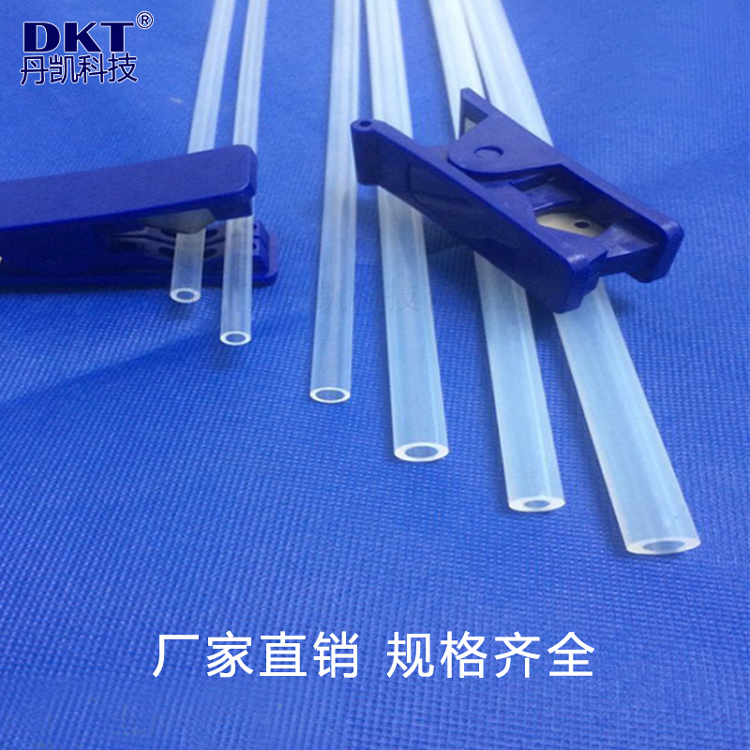
Shenzhen Dankai Technology Co., Ltd. (ShenZhen DanKai Technology Co., Ltd.), whose predecessor was the Fluoroplastic Material Factory of Dongguan Dandi Insulation Material Co., Ltd. established in 1998, specializes in the research and development, production and sales of FEP, PFA, PTFE and other fluoroplastic tube rod sheet membrane products and other insulation materials. The company has international standards of senior R & D team and the introduction of foreign fluorine plastic products production line. Some fluoroplastic products through ISO9001, SGS, FDA certification, Huawei, Foxconn, the United States, ZTE, Intel, AirTAC and other domestic and foreign cooperation customers fully affirmed. The company's main products are: ① pipes: Ptfe pipes, Fep pipes, Pfa pipes, Pvdf pipes; ② Heat shrinkable tubes: Ptfe heat shrinkable tubes, Fep heat shrinkable tubes, Pfa heat shrinkable tubes, Pvdf heat shrinkable tubes; ③ Plate rod film: Ptfe plate rod film, Feep plate rod film, Pfa plate rod film, Pvdf plate rod film, etc. PE: PE, special, spiral tube, spring tube, rotary cutting tube, welding rod, tee, straight, gasket, joint, cone rod, flared tube, sealing tube, braided tube, corrugated tube, etc. At the same time can be customized according to customer requirements processing production of various specifications of fluorine plastic products.
Key words:
Previous Page


Dankai Technology
Address: Area B, 4th Floor, Building 1, North Yongfa Science and Technology Park, Yanchuan North, Chaoyang Road, Songgang Town, Bao'an District, Shenzhen, China
Tel: +86-755-29979617 23127719 23127819
E-mail: dkt@szdankai.com

Focus on us
Copyright©2024 All rights reserved of Shenzhen Dankai Technology Co., Ltd.