PTFE, PFA, FEP, PVDF Fluoroplastic products industry experts

Analysis on Type and Structure of Heat Exchanger
Classification:
Industry dynamics
FAQ
Author:
Dankai
Source:
Dankai
Release time:
2021-12-08
Visits:
First, according to the use of heat exchanger classification
(1) Heater The heater is used to heat the fluid to the required temperature, and the heated fluid does not undergo phase change during the heating process.
(2) Preheater The preheater is used for preheating the fluid to improve the efficiency of the entire process device.
(3) Superheater The superheater is used to heat saturated steam to reach a superheated state.
(4) Evaporator The evaporator is used to heat the liquid to evaporate and vaporize it.
(5) Reboiler The reboiler is a special equipment for the distillation of the Dankai process, which is used to heat the condensed liquid and reheat it to vaporize it.
(6) Cooler The cooler is used to cool the fluid to the required temperature.
(7) Condenser The condenser is used to condense saturated steam to release latent heat and condense and liquefy it.
2. according to heat exchanger heat transfer surface shape and structure classification
(1) tube heat exchanger tube heat exchanger through the tube wall heat transfer, according to the structure of the heat transfer tube is different, can be divided into tube heat exchanger, tube heat exchanger, tube heat exchanger and fin tube heat exchanger and so on. Tubular heat exchangers are the most widely used.
(2) plate heat exchanger plate heat exchanger through the plate heat transfer, according to the structure of the heat transfer plate, can be divided into plate heat exchanger, spiral plate heat exchanger, plate fin heat exchanger and hot plate heat exchanger.
(3) special form heat exchanger This kind of heat exchanger refers to the heat exchanger with special structure designed according to the special requirements of the process. Such as rotary heat exchanger, heat pipe heat exchanger.

Figure 1: Heat exchanger Source: Dankai
Classification of 3. by materials used in heat exchangers
(1) Metal material heat exchanger Metal material heat exchanger is made of metal materials, commonly used metal materials are carbon steel, alloy steel, copper and copper alloy, aluminum and aluminum alloy, titanium and titanium alloy. Due to the large thermal conductivity of metal materials, the heat transfer efficiency of this type of heat exchanger is high, and the heat exchanger of metal materials is mainly used in production.
(2) Non-metallic material heat exchanger Non-metallic material heat exchanger is made of non-metallic materials, commonly used non-gold materials are graphite, glass, plastic and ceramics. This type of heat exchanger is mainly used for corrosive materials due to the small thermal conductivity of non-metallic materials, so its heat transfer efficiency is low.
Structure and Performance Characteristics of 4. Heat Exchanger
(I) tube heat exchanger
(1) tube heat exchanger tube heat exchanger, also known as shell and tube heat exchanger, is a common standard heat exchange equipment. It has the advantages of simple structure, large heat exchange area per unit volume, sturdiness and durability, wide use of materials, convenient cleaning and strong applicability. It is widely used in production and occupies a dominant position in heat exchange equipment. Tubular heat exchangers are divided into the following types according to the structural characteristics.
(2) Fixed tube sheet heat exchanger Figure 1-1 shows its detailed structure. The structural feature of this heat exchanger is that the two tube plates are respectively welded to the two ends of the shell, and the two ends of the tube bundle are fixed on the two tube plates. Its advantage is that the structure is simple, compact, and the tube is easy to clean. The disadvantage is that the shell cannot be mechanically cleaned, and when the temperature difference between the shell and the heat exchange tube is large (greater than 50 ℃), the resulting temperature difference stress (also called thermal stress) is destructive. Expansion joints need to be set on the shell, which is limited by the strength of the expansion joints. The fixed tube plate heat exchanger is suitable for the occasions where the shell side fluid is clean and does not scale, the temperature difference between the two fluids is not large or the temperature difference is large but the shell side pressure is not high.

Figure 2: Heat exchanger Source: Dankai
(3) Floating head heat exchanger The structure of the floating head heat exchanger is shown in Figure 1-2. Its structural feature is that one of the tube plates at both ends is not fixedly connected to the shell. It can freely expand and contract in the axial direction in the housing, and this end is called the floating head. The advantage of this kind of heat exchanger is that when there is a temperature difference between the heat exchange tube and the shell, when the shell or the heat exchange tube expands, it does not restrain each other and does not produce temperature difference stress; the tube bundle can be extracted from the tube, which is convenient for the cleaning between the tube and the tube. Its disadvantages are complex structure, large amount of material and high cost. The floating head heat exchanger is suitable for occasions where the shell temperature difference is large or the shell side fluid is easy to scale.
The heat pipe is divided into three types according to the condensate circulation mode: liquid-absorbing wick heat pipe, gravity heat pipe and Dankai centrifugal heat pipe. The condensate of the liquid-absorbing wick heat pipe returns to the hot end by capillary force, the condensate of the gravity heat pipe flows back to the hot end by gravity, and the condensate of the centrifugal heat pipe flows back to the hot end by centrifugal force. Heat pipes are divided into 4 types according to the working temperature range of the working fluid: cryogenic heat pipes, which work below 200K, and the working fluids include nitrogen, hydrogen, neon, methane, ethane, etc. Low temperature heat pipes, which work in the range of 200-550K, and the working fluids include freon, ammonia, acetone, ethanol, water, etc. Medium temperature heat pipes, which work in the range of 550~750K, the working fluid includes heat exchanger A, mercury, cesium, water, potassium and sodium mixture, etc. High temperature heat pipe, in? Work in the range of more than 50K, working fluid with potassium, sodium, lithium, silver and so on.
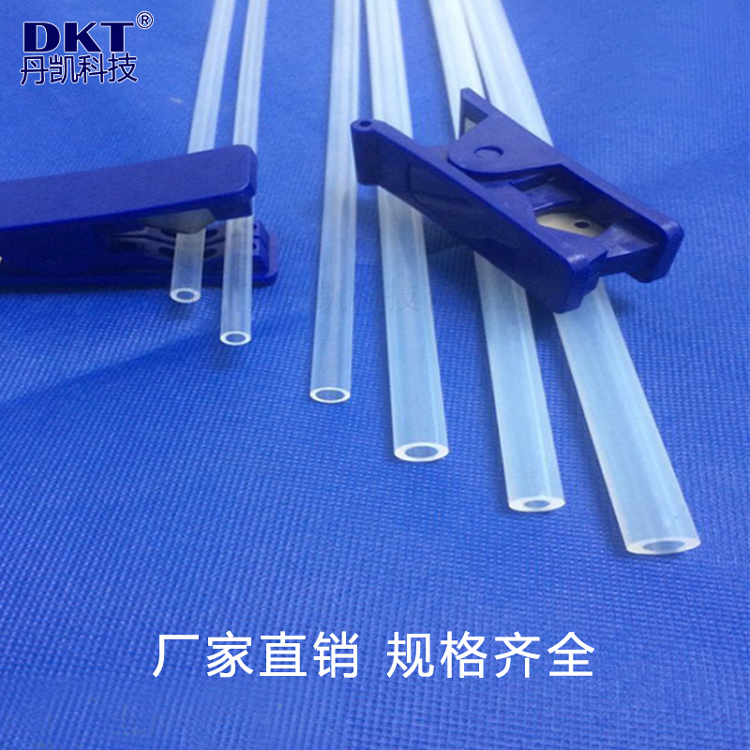
Shenzhen Dan Kai Technology Co., Ltd., specializing in FEP, PFA, PTFE, PVDF and other fluorine plastic tube rod sheet membrane products and other insulation materials research and development, production, sales and service of intelligent manufacturing enterprises.
ShenZhen DanKai Technology Co.,ltd. is an intelligent manufacturing enterprise specializing in the R & D, production, sales and service of FEP, PFA, PTFE,PVDF and other fluoroplastic tube, bar, sheet and film products as well as other insulating materials.
The company has international standards of senior R & D team and the introduction of foreign fluoroplastic products production line, some fluoroplastic products through ISO9001, SGS, FDA certification.
The main products are: ① Pipe type: Ptfe PTFE pipe, Fep pipe, Pfa pipe, Pvdf pipe; ② Heat shrinkable tube type: Ptfe heat shrinkable tube, Fep heat shrinkable tube, Pfa heat shrinkable tube, Pvdf heat shrinkable tube; ③ Plate rod film: Ptfe plate rod film, Feep plate rod film, Pfa plate rod film, Pvdf plate joint film, etc. ⑤, spiral tube, spring tube, rotary cutting tube, welding rod, tee, straight, gasket, joint, cone rod, flared tube, sealing tube, braided tube, corrugated tube, etc. At the same time can be customized according to customer requirements processing production of various specifications of fluorine plastic products.
This article is originally created by Teflon's little sister. Welcome to pay attention and take you to grow knowledge together!
Key words:
Type, heat exchanger, heat pipe, structure, used for, shell, fluid, temperature difference, metal material, material
Previous Page


Dankai Technology
Address: Area B, 4th Floor, Building 1, North Yongfa Science and Technology Park, Yanchuan North, Chaoyang Road, Songgang Town, Bao'an District, Shenzhen, China
Tel: +86-755-29979617 23127719 23127819
E-mail: dkt@szdankai.com

Focus on us
Copyright©2024 All rights reserved of Shenzhen Dankai Technology Co., Ltd.