PTFE, PFA, FEP, PVDF Fluoroplastic products industry experts

What material is PVDF? PVDF polyvinylidene fluoride application
Classification:
Industry dynamics
Author:
PFA tube little sister
Source:
Dankai
Release time:
2022-10-17
Visits:
PVDF polyvinylidene fluoride, the appearance of translucent or white powder or particles, closely arranged between molecular chains, and strong hydrogen bonds, oxygen index of 46%, non-flammable, crystallinity
65% ~ 78%, the density is 1.77~1.80g/cm3, the melting point is 172 ℃, the thermal deformation temperature is 112~145 ℃, and the long-term use temperature is -40~150 ℃.
1. what is PVDF?
PVDF is divided into two kinds of homopolymer and copolymer, so it is also called polyvinylidene fluoride and polyvinylidene fluoride.
now dankai teflon tube little sister to introduce to you what is the material of PVDF?
Poly(vinylidene fluoride), English abbreviation PVDF, mainly refers to vinylidene fluoride homopolymer or vinylidene fluoride and other small amounts of fluorine-containing vinyl monomer copolymer, it has
Fluorine resin and general-purpose resin characteristics, in addition to good chemical resistance, high temperature resistance, oxidation resistance, weather resistance, radiation resistance, but also has piezoelectric, dielectric
Special properties such as sex and pyroelectricity are the second largest products in fluoroplastics, with an annual global production capacity of more than 53000 tons.
The chemical structure is combined with a fluorine-to-carbon bond, and this structure with a short bond nature forms the most stable and strongest bond with hydrogen ions. Therefore, fluorocarbon coatings have specific physical chemistry.
Performance, not only has strong abrasion resistance and impact resistance, but also has high anti-fading and anti-ultraviolet properties in extremely harsh and harsh environments.
PVDF (polyvinylidene fluoride) has the strongest toughness, low friction coefficient, strong corrosion resistance, aging resistance, weather resistance, good radiation resistance and so on.

Figure 1: PVDF raw material source: Dankai
2. Teflon Tube Sister takes you to know the characteristics of PVDF (polyvinylidene fluoride)
1. Fluorinated resin (commonly known as thermoplastic Teflon) that can be injected and exited.
2. Excellent chemical resistance.
3. Wear resistance, high mechanical strength and toughness.
4, weather resistance, anti ultraviolet and nuclear rays.
5, good heat resistance and high dielectric strength.
Application: chemical resistant parts, wire and cable, etc.

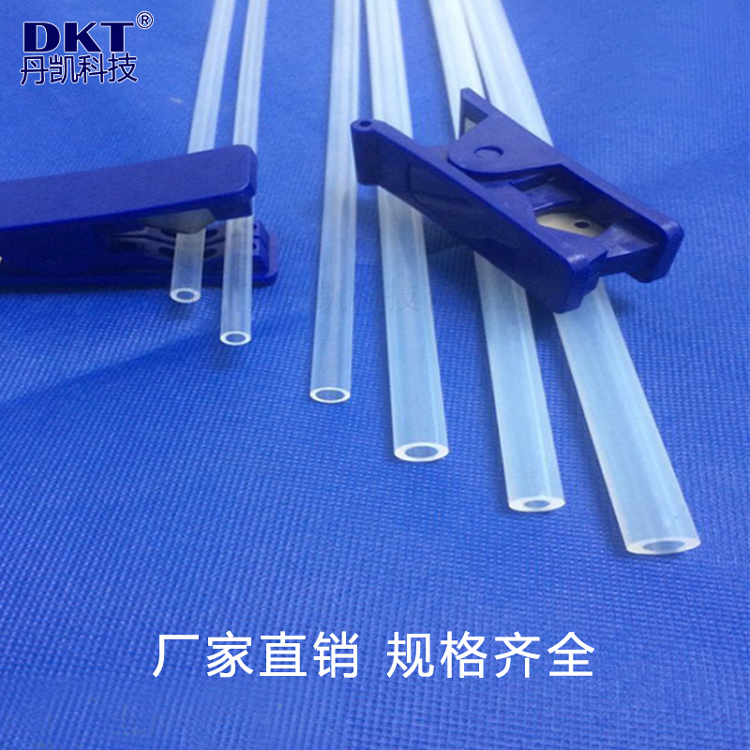
Figure 2: PVDF tube Source: Dankai
3. processing conditions processing environment
Forming conditions: dry: original package does not need to dry
Injection temperature: 180~230 ℃
Mold temperature: 60~90 ℃
Betting temperature: 180~265 ℃
Die: 66~140 ℃
4. PVDF pipe connection
1. Generally, we often use hot air welding connection and hot melt butt connection in PVDF pipe connection. During the connection process, the temperature must be appropriate.
And stable, and when welding should pay attention to keep the welding surface clean, to avoid doping a lot of impurities and affect the performance, it is important to control the temperature as far as possible to choose PVDF tube
The molten state of the road should not be burnt. During welding, attention should also be paid to the fact that there is no gap between the two connected bodies.
2. Precautions for selecting PVDF tube
To consider the environment around the installation of this PVDF pipe, to determine whether the temperature is above 100 degrees Celsius, the higher the temperature, the higher the coefficient to be selected, this
The sample can ensure the service life, and for the environment where the temperature is lower than 40 degrees Celsius, we should pay attention to the choice of the better compression resistance, and try to choose the pipe wall is more uniform.
Application of 5. PVDF Polyvinylidene Fluoride
PVDF applications are mainly concentrated in the petrochemical, electrical and electronic and fluorocarbon coatings three major areas, due to PVDF good chemical resistance, processability and fatigue and creep resistance, is the petrochemical
One of the best materials for pumps, valves, pipes, pipe fittings, storage tanks and heat exchangers for integral or lined fluid handling systems of industrial equipment.
Dankai PVDF good chemical stability, electrical insulation properties, so that the production of equipment to meet the TOCS and flame retardant requirements, is widely used in the semiconductor industry, high purity chemicals storage.
Storage and transportation, the use of PVDF resin made of porous films, gels, diaphragms, etc., in lithium secondary batteries, the use of the current use of PVDF demand for one of the fastest growing markets.
PVDF is one of the most important raw materials of fluorocarbon coatings, fluorocarbon coatings prepared as raw materials have been developed to the sixth generation, due to the PVDF resin has super weather resistance, can be in the outdoor long
This kind of coating is widely used in power stations, airports, highways, high-rise buildings and so on. In addition, PVDF resin can also be blended with other resins,
For example, PVDF and ABS resin are blended to obtain composite materials, which have been widely used in construction, automobile decoration, home appliance shells, etc.
What kind of material is PVDF? I believe you have a certain understanding. I will give you a detailed introduction to the relevant properties and applications of PVDF. The relevant prices and physical properties of PVDF materials can be used.
consulting teflon tube little sister.
This article is originally created by Teflon's little sister. Welcome to pay attention and take you to grow knowledge together!
Key words:
Pvdf, resin, performance, with, corrosion-resistant, aging-resistant, weather-resistant, low friction coefficient
Previous Page
Previous Page


Dankai Technology
Address: Area B, 4th Floor, Building 1, North Yongfa Science and Technology Park, Yanchuan North, Chaoyang Road, Songgang Town, Bao'an District, Shenzhen, China
Tel: +86-755-29979617 23127719 23127819
E-mail: dkt@szdankai.com

Focus on us
Copyright©2024 All rights reserved of Shenzhen Dankai Technology Co., Ltd.