PTFE, PFA, FEP, PVDF Fluoroplastic products industry experts

Post-treatment process of polytetrafluoroethylene (PTFE)
Classification:
Industry dynamics
Author:
PFA tube little sister
Source:
Dankai
Release time:
2022-11-22
Visits:
Polytetrafluoroethylene (PTFE) was first developed by DuPont in 1938, was tested in 1941 and industrialized in 1949. It is currently one of the most advanced fluoroplastics, application
The most extensive, the largest output, accounting for about 89 to 95% of the world's fluorine plastic production. PTFE is a non-polar linear crystalline polymer, white, odorless, tasteless, non-toxic powder, concentrated
The dispersion liquid is a Milky White liquid. At present, PTFE with its good chemical resistance and high and low temperature resistance as a gasket and other sealing components are widely used in petroleum, chemical, food, medicine
equipment and devices, but its shortcomings of easy creep severely limit the application of this material. This paper analyzes the influence of post-treatment process on the performance of PTFE sealing material,
The experimental fixture is designed to play a good role in the modification of PTFE.
The post-treatment process of polytetrafluoroethylene (PTFE) includes the stretching process and the heat treatment process, and the characteristics of the two processes are described below.

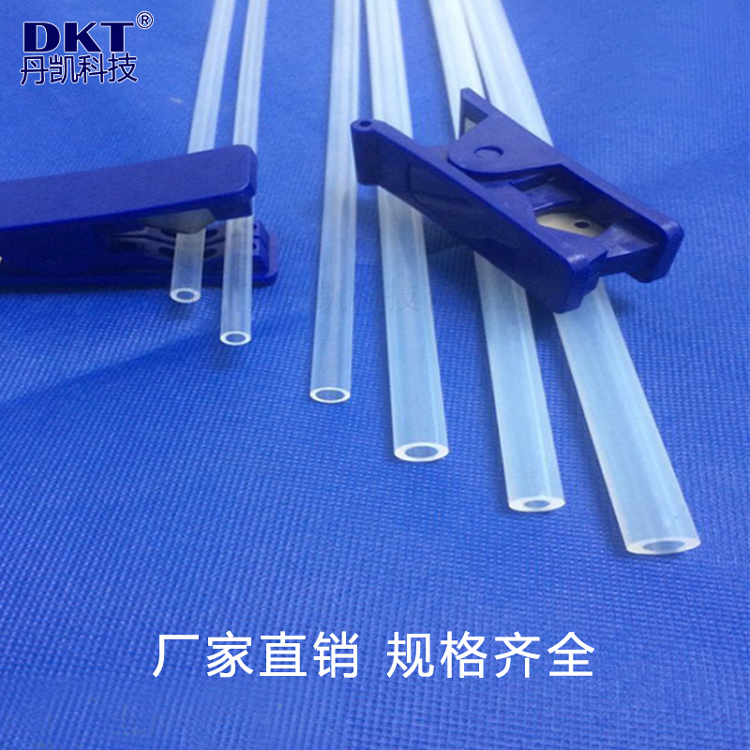
Figure 1: PTFE tube Source: Dankai
1. drawing process
The crystal structure of the composite material fundamentally ensures the performance of the product, and the stretching process is an improvement on the existing PTFE molding process, which can fundamentally change the crystal structure and shape of PTFE.
appearance structure. Therefore, the correct selection of tensile process parameters is very important in the preparation of modified PTFE gasket sealing materials. When selecting the stretching process parameters, the stretching rate and stretching must be considered comprehensively.
ratio, stretching temperature and other factors on the performance of the product.
The stretching process is divided into one-way stretching and two-way stretching.
1. Unidirectional stretching
In practical applications, uniaxial stretching can improve the performance of PTFE in the stretching direction, but the degree of performance improvement is still limited. However, the unidirectional tensile process is simple and can be used in the test.
Use.
In the single stretch, the PTFE nodes begin to extend, and the microfine fibers are parallel to the stretching direction. The polytetrafluoroethylene structure obtained by stretching under high temperature and high speed conditions can be obtained
The nodes of uniform spatial structure, which are connected with a large number of polytetrafluoroethylene fibers to form a high-quality network, and can be stretched at high temperature and high speed to increase the strength of the product.
2. Two-way stretching
Bidirectional stretching includes stretching from longitudinal stretching and transverse stretching, at a certain temperature and set speed, at the same time or step by step in two perpendicular directions (longitudinal and transverse), and then through
Appropriate heat treatment, through the two-way stretching of PTFE, the performance in the two vertical directions is greatly improved, and the comprehensive performance meets the needs of practical application. There are many kinds of two-way stretching method, the actual should be
The use should be determined according to the performance requirements of the product, the scale of production and the characteristics of the production technology and equipment.
By changing the process conditions, and the position and temperature field, can be obtained in both directions of the physical and mechanical properties of the same (isotropic) plate, can also be made in one direction of the mechanical properties higher than the other.
anisotropic sheet in the direction. This is due to the fact that in two-way stretching, which direction is used in the longitudinal and transverse directions, the fibers are longer and more in number. Increase stretch ratio
to increase the length of the fiber. The size and shape of the node are related to the stretching ratio. The shape of the node of the product under uniaxial stretching is a slender oblate sphere, and the node of the product under biaxial stretching is close to spherical. Fiber length, thick
Fine and stretching, heat setting conditions, and the nature of the fiber affects the mechanical properties of the product, in short, by controlling the stretching direction, stretching ratio, stretching rate and other factors, can control the polytetrafluoroethylene.
The structure of the olefin gasket article, which in turn controls its mechanical properties.
In the process of biaxially stretching PTFE sheet, due to the polymer in the longitudinal and transverse directions experienced a certain stretching, changing the arrangement of molecules and chain segments, therefore, the main properties of the stretched sheet
There is a significant change in the non-tensile sheet. Mechanical properties, creep resistance, resilience and flexibility have increased significantly.
Figure 2: PTFE tube Source: Dankai
3. Normal temperature stretching and high temperature stretching
The stretching of the sheet can be carried out from room temperature to near the melting point (327 ° C.) of polytetrafluoroethylene. Generally speaking, when the temperature is low, the stretching ratio and stretching rate are limited, which is caused by the polymer.
The mechanical properties of the decision. When the temperature is high, the polymer chain is easy to deform, and the stretching ratio and speed can be increased accordingly. High-temperature stretching is generally carried out between 250 and 300°C.
4. Stretch ratio and stretch rate
The size of the stretch ratio is one of the important factors affecting performance. The stretching ratio is expressed by the ratio of the length of the sample after stretching to the length of the sample before stretching. With the increase of the stretch ratio, the tensile strength and elongation of the product.
And softness increases, apparent density decreases, so the increase in stretch ratio is beneficial to the performance of the article. But the stretch ratio is too large, the product is easy to break and difficult to form. The stretch ratio is mainly affected by the type of resin, drying temperature,
The influence of the cross-sectional area of the product. In general, the draw ratio should be selected between 2 and 7.
The tensile rate is generally less than 1 m/min. If a higher tensile strength is required, the tensile speed should be increased.
2. heat treatment process
The selection of suitable heat treatment methods and conditions is the main way to improve the performance of PTFE plates. The specimens are subjected to heat treatment after stretching, the purpose of which is to accelerate the secondary crystallization or crystallization of the polymer.
process, so that the molecular chain orientation into crystalline orientation, eliminate internal stress, improve crystallinity, so that the crystal structure tends to be perfect, so that the size of the stability and so on. However, in high temperature processing, the higher the temperature, the material
The more obvious the mechanical properties decrease. Therefore, the appropriate heat treatment conditions must be selected according to the performance requirements of the sample.
1. Heat setting
The sheet must be heat-set after stretching. After the polymer is stretched, heating will cause the molecular chain to recover the state before stretching, which will cause the warping of the plate macroscopically. So when heat setting, in the direction of material stretching
To maintain a certain tension, so as not to affect the performance and appearance of the material. Such as completely no tension under heating, will make the plate serious deformation. This study uses a clamp clamp to keep the tension and make the plate
During heating, a certain tension is maintained in the stretching direction.
When the stretched preform is heated above the melting point, the crystalline phase gradually transforms into an amorphous phase, and the amorphous part of the crystalline structure slides along the crystalline axis due to the resistance of fibers and nodes.
This sliding is prevented under stress. Therefore, the heat setting process can be regarded as a fixing process of the amorphous part. The microstructure of PTFE does not occur essentially at the stage of amorphous phase fixation.
However, if the amorphous part is at a high temperature for a long time, the microstructure will change, the nodes will increase, and the fibers will be destroyed, resulting in a decrease in the strength of the product. The heat treatment temperature is higher
At 390 ℃, it may cause decomposition and loss of strength within one minute.
2. Cooling
The cooling process is a process from amorphous phase to crystalline phase, which is a relaxation process in which macromolecular chain segments are rearranged into the lattice and changed from disorder to order. The cooling rate determines the crystallinity of the product, the shadow.
To the various physical and mechanical properties of the product. The maximum crystallinity of polytetrafluoroethylene occurs at a temperature of 10 to 20°C below the melting point, I .e., in the temperature range of 310 to 315°C. Cooling method package
There are two types: slow cooling (not quenching); rapid cooling (quenching).
Slow cooling means direct cooling at a suitable rate in the air, and the crystallinity of the resulting products is larger, the shrinkage rate is larger, and the shrinkage rate of the products is larger.
Rapid cooling means that the stretched sample is placed in water or air at the fastest speed through the temperature region with the highest crystallization speed for cooling, so that a large number of amorphous regions are preserved in the product.
The resulting products have low crystallinity, good toughness, low hardness, high tensile strength, and small product shrinkage; but they are prone to cracks, resulting in waste products.
In the process, large stress will be generated to bend or deform the product. However, if the product is pressurized and cooled during rapid cooling, that is, the stretched sample is pressed into the cold mold cavity and cooled under 1/3 of the preforming pressure.
The product will not show the defects caused by rapid cooling to the product and the quality is close to the product obtained by slow cooling.
This article is originally created by Teflon's little sister. Welcome to pay attention and take you to grow knowledge together!
Key words:
PTFE, stretch, product, process, performance, cooling, temperature, direction
Previous Page


Dankai Technology
Address: Area B, 4th Floor, Building 1, North Yongfa Science and Technology Park, Yanchuan North, Chaoyang Road, Songgang Town, Bao'an District, Shenzhen, China
Tel: +86-755-29979617 23127719 23127819
E-mail: dkt@szdankai.com

Focus on us
Copyright©2024 All rights reserved of Shenzhen Dankai Technology Co., Ltd.