Polytetrafluoroethylene, commonly known as "non-stick coating" or "easy-to-clean wok material"; is a synthetic polymer material that uses fluorine to replace all hydrogen atoms in polyethylene. This material has anti-acid resistance
Alkali, resistance to various organic solvents, almost insoluble in all solvents. At the same time, PTFE has the characteristics of high temperature resistance, its coefficient of friction is very low, so it can be used for lubrication, but also
Ideal paint for the inner layer of wok and water pipe for easy cleaning.
Chinese alias: PTFE; Teflon; Teflon; Teflon; F4; Plastic King.

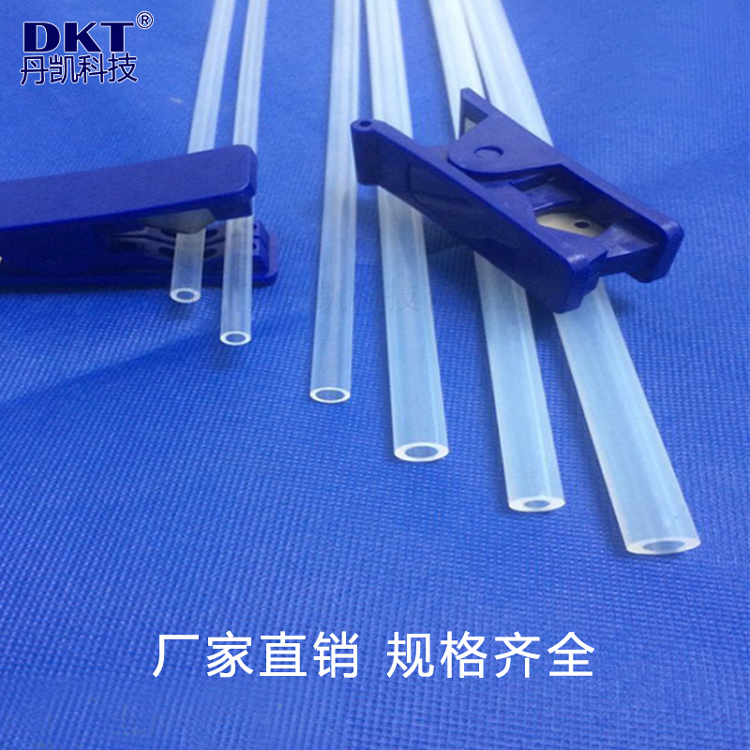
Figure 1: PTFE tube Source: Dankai
Advantages
High temperature-the use of working temperature of 260 ℃.
Low temperature resistance-has good mechanical toughness; even if the temperature drops to -196 ℃, it can maintain 5% elongation.
Corrosion resistance-for most chemicals and solvents, showing inert, strong acid and alkali, water and various organic solvents.
Weather-resistant-has the best aging life in plastics.
High lubrication-is the lowest coefficient of friction in solid materials.
No adhesion-is the smallest surface tension in a solid material and does not adhere to any substance.
Non-toxic-physiologically inert, as a long-term implantation of artificial blood vessels and organs without adverse reactions.
Electrical insulation-can resist 1500 volts high voltage.

Figure 2: PTFE tube Source: Dankai
Disadvantages
1, PTFE has "cold flow". That is, the plastic deformation (creep) of material products under long-term continuous load, which brings certain restrictions to its application. For example, when PTFE is used as a seal
When the gasket is tightened for tight sealing, the bolt is tightened so that when the specific compression stress is exceeded, the gasket will produce "cold flow" (creep) and be flattened. These shortcomings can be achieved by adding appropriate fillers and
Improve the parts structure and other methods to overcome.
2, PTFE has outstanding non-viscosity, limiting its industrial application. It is an excellent anti-sticking material, which in turn makes it extremely difficult to bond to the surface of other objects.
The linear expansion coefficient of PTFE is 10 to 20 times that of steel, which is larger than most plastics, and its linear expansion coefficient changes very irregularly with the change of temperature. In the application of PTFE, if this aspect
Can pay attention to not enough, it is easy to cause losses.

Figure 3: PTFE tube Source: Dankai
Physical Reasons for Difficult Bonding of 2. Teflon Tube
In the process of using PTFE tubes, we found that PTFE tubes are difficult to bond. Do you know the physical reasons for this phenomenon?
Due to the poor wetting performance of the PTFE tube surface, it can not be well bonded, thus greatly limiting its scope of use, in order to make PTFE have a wider range of applications, the surface treatment to improve the adhesion
It is necessary to improve the bonding strength.
The reasons that may cause the PTFE tube to be difficult to bond are as follows:
First of all, the surface of PTFE tube is lower, the critical surface tension is generally the largest of all materials, and the greater the contact angle, the smaller the degree of wetting, that is, the worse the wettability, the adhesive can not fully wet PTFE,
It does not adhere well to PTFE.
In addition, the PTFE tube has a large crystallinity, a highly symmetrical structure, and belongs to a non-polar polymer. Adhesive adsorption on the PTFE surface is caused by intermolecular forces, which include orientation
The non-polar surface of PTFE does not have the conditions to form the orientation force and the induced force, and can only form a weak dispersion force, so its adhesion performance is poor. The solubility parameter is very small,
Therefore, the adhesion with other substances is also very small.
This article is originally created by Teflon's little sister. Welcome to pay attention and take you to grow knowledge together!