PTFE, PFA, FEP, PVDF Fluoroplastic products industry experts

Analysis of PTFE sintering production process and push molding production process
Classification:
Industry dynamics
Author:
PFA tube little sister
Source:
Dankai
Release time:
2022-12-03
Visits:
Sintering is the key to the molding of PTFE products. The PTFE sintering process is a phase change process. The form is heated to 327 the resin melting point temperature. Above C, the crystal part in the macromolecular structure is completely transformed into none
Shaped structure, the appearance of the object is transformed from a white opaque body to a colloidal elastic transparent body. Insulation for a period of time, until the process is fully completed, and then cooling, so reasonable determination, control of sintering.
process and its process conditions are important factors to ensure the quality of products.
(1) Cracks
There are many reasons for cracks. Poor thermal stability of the resin, excessive molding pressure or insufficient impact pressure pressure, uneven feeding during molding, insufficient feeding or batch feeding, sintering when the shape blank placement method.
Or improper location, sintering temperature is too high or holding time is too long, heating speed is too fast, cooling too fast, etc. are the causes of cracks. The method of prevention is: choose a good stability of the resin, the use of suitable.
When the molding pressure, and the pressure process to be slow; sintering, take a reasonable sintering process, such as heating speed and cooling speed is not too fast.
(2) Deformation
The deformation is due to uneven feeding, poor thermal stability of the resin, internal cracking after sintering, concave surface, uneven pressure during molding, too short holding time, uneven temperature in the furnace, and placement during sintering
Improper, cooling too fast and other reasons. Pay attention to the feeding, the pressure should be uniform, the high and large products should be pressed at both ends, the pressure holding time should be increased, and the cooling speed should be appropriate.
(3) Bubbles
The reason is that the air in the shape blank is not exhausted, the resin contains too much volatile matter, or the sintering temperature is too high, pay attention to slow pressure rise, midway to exhaust, resin to pre-heat treatment, appropriately reduce the sintering temperature.
(4) The reason why the size does not meet the requirements is mainly due to the improper matching of the mold structure size and the resin shrinkage rate, and the improper feeding amount will also cause the size to be incorrect.
(5) The turning film has water stain-like markings, indicating that the blank is not burned through, to increase the sintering temperature, the appropriate extension of the insulation time.

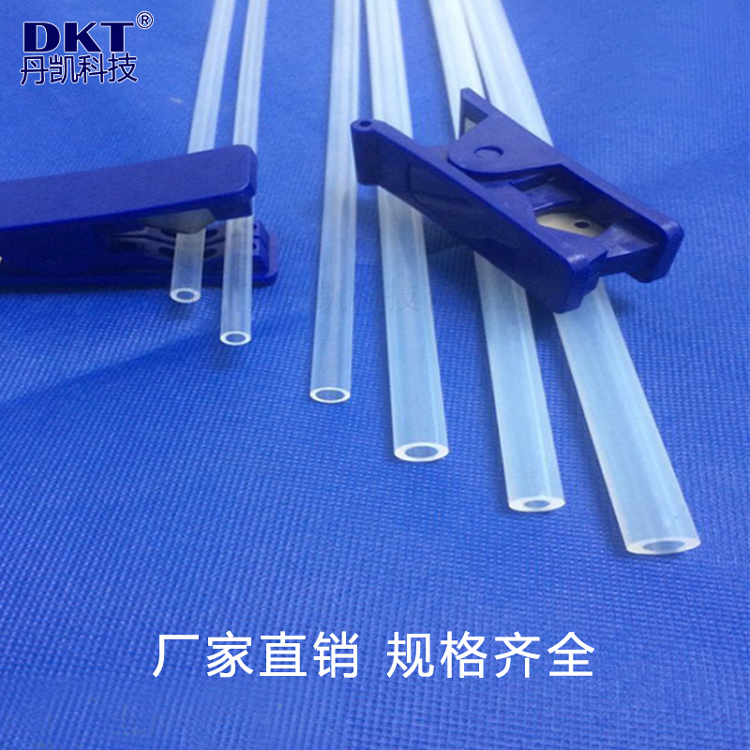
Figure 1: PTFE tube Source: Dankai
The pre-formed billet after mixing the human-assisted extrusion agent in the polytetrafluoroethylene resin, using mechanical methods to force the billet through a mold with a certain cone angle to produce a uniform arrangement of fibers, and then remove the help extrusion.
After sintering, it is a product with a certain mechanical strength, this whole process is called the whole process of push molding. The diameter of the secondary particle after coagulation of the polytetrafluoroethylene dispersion used is about 5001 ~ m (using
Emulsion polymerization resin), the primary particle diameter of 0.2-0.3 m or so, this resin than the surface area is large, after absorbing organic solvents, after the action of shear force to form a paste paste, extrusion molding, and
Called paste extrusion molding.
Push molding features: dispersed polymer resin, it is easy to become fibrous after shear force. The formation process of the fiber is: a pre-formed blank with additives, which is not subject to shear in the cavity.
Use, the original material is compressed parallel forward, in the material cavity and cone mold middle, partially accelerated, until the cone mold and die joint, shear effect is obvious, close to the mold wall resistance increases, pushing speed
The degree of decline, when the fine particles are fibrous and pulled into long strips. A very important parameter in the pushing process is the compression ratio. Defined as the ratio of the cross-sectional area of the material cavity to the cross-sectional area of the product: S section cavity
Area/S die cross-sectional area = R. R(Reduction Ratio) For pipes, it refers to the ratio of the difference between the cross-sectional area of the material cavity and the area of the mandrel to the difference between the cross-sectional area of the die and the cross-sectional area of the mandrel:
R.R=(D -D )/(d -d )中:D,-(mm);
D -- outer diameter of mandrel (mm);
d-Die inner diameter (mm);
D-mandrel outer diameter (mm).
In order to facilitate the reader's understanding, the push material flow model is introduced.
1. Cavity 2. Cone die 3. Mouth die 4. Flow line 5. Fiber-like material 6. Poulant
The preform (billet) is generally carried out on a high-stroke press. The operation process is similar to molding. Add the mixed qualified material into the mold cavity, close the mold and move it into the press, then slowly raise the pressure and the pressure.
During the process, the pressure shall be released twice, and the pressure shall be kept for 2min under the condition that the unit pressure is 0.39~2.94MPa(5~30 kg/cm), and the pressure shall be released. After demoulding, the product shall be stored in a sealed container. I want to push immediately.
Press molding, not suitable for long-term storage. Pre-formed billet density at (1.6).
Push forming is the most important part of the whole process. The whole operation process is as follows: first select the mold, install the mold, and carefully correct the center position of the mold installation. Select according to product requirements
After the material cavity and mold are completed, the three plates of the mandrel fixing plate, the piston fixing plate and the material cavity fixing plate are parallel, and the mandrel is perpendicular to the three plates, so as to ensure the uniformity of the wall thickness of the pipe. Will be blank
After trimming, the material is added to the barrel of the pushing machine, the plunger is lowered, the pushing forming is started according to the set process conditions, and the pushing pipe and other products are subjected to the following process, I .e. the drying, sintering zone length and product specifications.
Match each other, in the design of process conditions to be considered as a whole, from the guarantee of product quality, coordinate the push speed, drying time, sintering temperature and time, so that the push, drying, sintering and other process coordination.
carried out.
Usually the pushing speed is 0.1~20 M/min, the compression ratio is 500~1000, and the die angle is 20~60., The aspect ratio of the die is 8~10, and the inner surface of the die must be smooth. These conditions are guaranteed.
Necessary conditions for product quality. In order to obtain a good product, uniform fibrosis must be realized, and the pushing temperature factors must be controlled, I .e. the temperature of the material cavity is 30~35 ℃, and the temperature of the die is 50~60 ℃.
In an environment where the temperature is lower than 20 ℃, pushing and pushing is also called paste extrusion molding. The dispersed resin screened with 20~30 mesh and organic additives (toluene, petroleum ether, solvent oil, etc., are mixed with a resin weight of 1/
5) Mix to make a paste, pre-press into a thick-walled cylindrical blank, put it into the barrel of the pushing machine, heat it, and press it with a plunger. After drying at 360°C.
(1)PTFE has a very high viscosity in the molten state, and will not change from a high elastic state to a viscous fluid state when heated to 415°C; the melt viscosity decreases with the increase of shear stress, showing the characteristics of non-Newtonian fluids.
(2)PTFE is a crystalline polymer. The main factors that directly affect the crystallinity of the product are the sintering temperature and time during molding. When the temperature exceeds 327. C, the crystallization area is completely disappeared;
When the temperature is lower than this temperature, it crystallizes again. The degree of crystallinity is related to the cooling rate and relative molecular weight after sintering. The cooling speed is fast, the crystallinity is small, the cooling speed is slow, and the crystallinity is high. in a certain cooling
The greater the relative molecular weight, the smaller the crystallinity; the smaller the relative molecular weight, the greater the crystallinity. Therefore, in order to obtain good PTFE products, the sintering process must be strictly controlled.
This article is originally created by Teflon's little sister. Welcome to pay attention and take you to grow knowledge together!
Key words:
Production process, sintering, pushing, molding, resin, temperature, products, speed, cooling, time


Dankai Technology
Address: Area B, 4th Floor, Building 1, North Yongfa Science and Technology Park, Yanchuan North, Chaoyang Road, Songgang Town, Bao'an District, Shenzhen, China
Tel: +86-755-29979617 23127719 23127819
E-mail: dkt@szdankai.com

Focus on us
Copyright©2024 All rights reserved of Shenzhen Dankai Technology Co., Ltd.