PTFE, PFA, FEP, PVDF Fluoroplastic products industry experts

Experimental Study on Surface Modification of Polytetrafluoroethylene by Plasma
Classification:
Industry dynamics
Author:
PFA tube little sister
Source:
Dankai
Release time:
2022-12-20
Visits:
PTFE PTFE is a kind of excellent polymer material, the material high temperature resistance, corrosion resistance, excellent dielectric properties, chemical stability and good mechanical properties, because
This material is widely used in engineering, military, all aspects of life. However, PTFE polymer is non-polar, and the surface free energy is very low, which makes it.
The wettability and hydrophilicity of the surface are very poor, which affects its wide application in real production.
There are many surface modification treatment methods, and this experiment uses the plasma treatment method in the dry treatment method. The treatment time is short, pollution-free, and only changes the surface properties of the material
Affect other properties of the material. RF plasmas typically utilize high frequency power at a frequency of 13.56MHz coupled to a working gas to discharge it to produce a plasma. Plasma
PTFE, causing defluorination, crosslinking, the formation of carbon-hydrogen bonds and oxygen, nitrogen-containing groups, so that its surface polar components increased, hydrophilic increased, improve wettability and
Cohesiveness. According to the coupling mode of high frequency power, RF plasma can be divided into inductive coupling and capacitive coupling.
In this experiment, the inductive coupling method is used. The quartz tube is used as the reaction chamber, and a certain number of turns of the inductive coil is wound outside the quartz tube. The radio frequency power is coupled to the reaction gas through the inductive coil.
Go in the body. The energy of the plasma can be applied to the polymer surface by light radiation, neutral molecular flow and particle flow, and the dissipation process of these energies is the root of surface modification.
This reason.

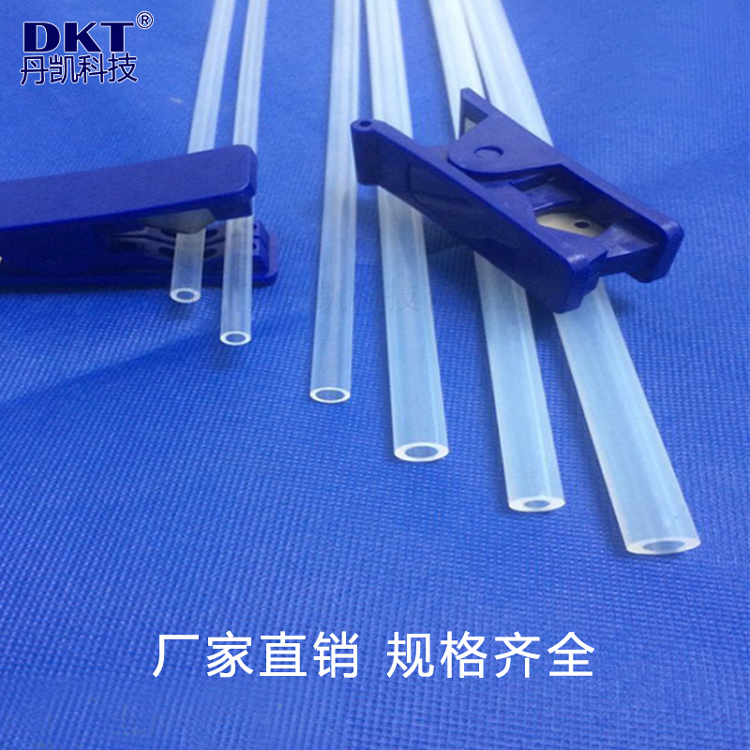
Figure 1: PTFE tube Source: Dankai
1. Experimental part
1.1 experimental materials and research methods
500W RF power source plasma equipment. The RF power source is at a frequency of 13.56MHz. Static contact angle meter. Handle samples are commercially available as thin PTFE 0.05mm thickness
Membrane.
First of all, the PTFE film sample is prepared, treated with a certain condition of plasma, and then the contact angle meter is used to measure the contact of deionized water on the PTFE film.
Antennae, take five to six different places of the material for photographing and recording. Finally, select the surface tension value of the liquid at the current temperature, and use Image analyze software and
Simple CAST software to calculate the contact angle, take the average to obtain the final contact angle.
1.2 experimental condition records and experimental results
The experimental results show that:
On the whole, before the treatment time of 60s, the contact angle decreased by 12 ° ~ 15 °, and after 60s, the contact angle increased in different degrees. The appropriate processing time can
The contact angle is reduced, and the contact angle rebound increases beyond the appropriate time. Oxygen treatment, the contact angle decreased the fastest, more than the best time range, the rebound is the most. Nitrogen
Finally, it remained stable, and the contact angle of argon and air treatment fluctuated.
At the same pressure, the oxygen atmosphere contact angle decreases by up to 17 °. However, high power can only accelerate the rate of contact angle reduction, and high power makes the late change of contact angle fluctuate.
After the argon plasma with the same pressure and different power modifies the surface of PTFE, the contact angle before and after treatment is reduced by about 15 degrees at most, which is similar to oxygen treatment,
High power increases the rate of contact angle decrease, but the contact angle exhibits more fluctuations during argon plasma treatment.
It follows that high power oxygen and argon plasma treatments are less optimal than low power plasmas. Hydrogen plasma treatment can significantly reduce the contact angle.
The contact angle decreases from 115 ° to about 60 ° before and after treatment.
2. Analysis of experimental results
Plasma treatment of PTFE PTFE, generally will cause defluorination, crosslinking, the introduction of carbon-hydrogen bonds, oxygen-containing groups, etc., thus destroying the high degree of symmetry of PTFE molecules
It improves its hydrophilic and wetting properties.
Oxygen plasma contains a large number of active ions, generally containing excited oxygen molecules and oxygen atoms, may also produce negative oxygen ions, these particles can occur oxidation etching
The effect, especially the etching effect, is extremely strong. Pure oxygen plasma treatment of PTFE, due to the role of a large number of active particles, PTFE is strongly etched, but also a series
In this experiment, the contact angle of PTFE treated with plasma in oxygen alone atmosphere changed by only 15 degrees at most, which can also be attributed to other chemicals besides C- O bonds.
Less bond, the non-polar change is not big, the contact angle has a certain decrease, but with the increase of processing time, the etching effect of oxygen plasma is the main factor, so that
The oxygen-containing groups are reduced due to the moment effect, so that the wettability performance is reduced to a certain extent, and the contact angle is increased to a certain extent.
Argon is an inert gas, and argon is a non-reactive gas in plasma processing. Argon atoms cannot be directly grafted to the macromolecular chains on the surface of the polymer, but due to the argon
When high-energy particles bombard the surface of the material in the gas plasma, the carbon-carbon bond and the carbon-fluorine bond can be broken, and a large number of free radicals are generated on the surface of the material. PTFE in plasma treatment
The new free radicals generated after the treatment are kept for a long time, which makes the oxygen in the air interact with the free radicals after the treatment is completed, thus increasing the polarity and hydrophilicity of PTFE.
Strong.
Before and after the treatment of PTFE by hydrogen plasma, the contact angle was improved. Specifically, the following speculation can be made that the hydrogen plasma contains a large number of hydrogen ions-, and
After PTFE is bombarded by plasma high energy, the carbon-fluorine bond is opened. F is an atom with strong electronegativity, which can combine with hydrogen ions to form hydrogen bonds, and PTFE becomes no longer highly symmetrical.
The. For polar molecules, such as HF and NH3, it is due to hydrogen bonding that they are extremely soluble. It is speculated that the introduction of hydrogen bonds makes PTFE water absorption stronger.
Reason.
3. Conclusion
After surface treatment of PTFE by air, nitrogen, argon and hydrogen plasma, the contact angle is reduced, the wetting performance is improved, and the bonding effect is obviously increased.
In addition, the surface energy is improved, especially the polar component is obviously increased, so that its surface performance is optimized, among which, the hydrogen plasma treatment results are the best, and the contact angle is reduced.
To. In addition, the high power plasma can make the modification faster, but not all the gas atmosphere to increase the power can make the contact angle further reduced, such as oxygen and argon
Gas plasma, high power is not as effective as low power.
This article is originally created by Teflon's little sister. Welcome to pay attention and take you to grow knowledge together!
Key words:
Ptfe, polytetrafluoroethylene, polymer material, high temperature resistance, corrosion resistance, excellent dielectric properties, chemical stability


Dankai Technology
Address: Area B, 4th Floor, Building 1, North Yongfa Science and Technology Park, Yanchuan North, Chaoyang Road, Songgang Town, Bao'an District, Shenzhen, China
Tel: +86-755-29979617 23127719 23127819
E-mail: dkt@szdankai.com

Focus on us
Copyright©2024 All rights reserved of Shenzhen Dankai Technology Co., Ltd.