PTFE, PFA, FEP, PVDF Fluoroplastic products industry experts

Introduction of Polytetrafluoroethylene (PTFE) Molding Technology
Classification:
Industry dynamics
Author:
PFA tube little sister
Source:
Dankai
Release time:
2022-12-26
Visits:
Dankai PTFE mainly has molding, hydraulic, pushing, extrusion, spraying, bonding, welding and winding the most common molding technology. The first five are directly processed into PTFE resin
The latter three are processed into various products with Dankai PTFE plastic plates or thin strips. In addition to rolling method, thermoforming method and other molding methods. Now briefly introduce a variety of molding
Methods.
1. Molding method
Molding mostly uses suspension resin, when the thickness of less than 1.5mm thin plate, it is necessary to use dispersion resin. The process: resin-sieving (suspended resin by mashing, loosening
Moving and sieving through a 20-mesh sieve)-press (PTFE powder loaded into the mold is compacted and formed by the press under a pressure of 20-235Mpa)-sintering (sintered at a temperature of 370-380 ℃
Sintering in the furnace)-molded products (after cooling and shaping in the mold or free state, they become the required plates, rods, tubes, gaskets and packing products, etc.).
2. Hydraulic method
Hydraulic method, also known as equal pressure method or rubber bag method, is a special method for making PTFE products. It is to apply hydraulic pressure to the rubber bag to expand the PTFE resin to the mold and make it
After compaction and sintering into products, the basic operation process is as follows: place the rubber bag in the outer mold-connect the water pump, fill the tap water to make the rubber bag expand into a cylindrical shape-resin is evenly added to the bag and the outside.
Between the molds-close the mold-continue to fill water and gradually increase the water pressure. When the pressure reaches 12-13Mpa, keep the pressure for 30min and then drain the water-reduce the pressure, remove the mold, sinter and cool the preform with smooth appearance.

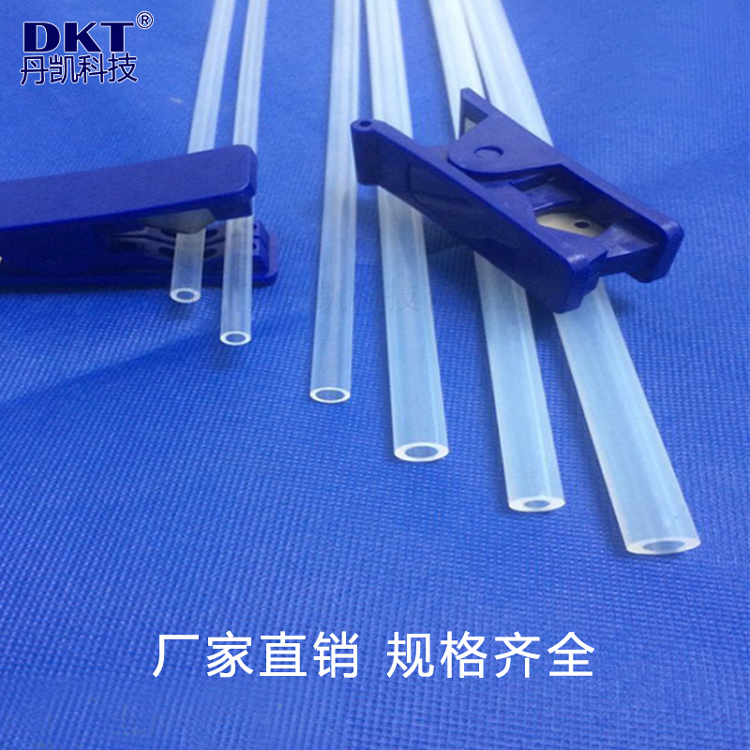
Figure 1: PTFE tube Source: Dan Kai
3. Push method
Push also known as paste extrusion molding, the 20-30 mesh sieve dispersion resin and organic liquid (toluene, petroleum ether, solvent oil, etc.) prepared into a 1:5 paste mixture, pre-pressure
Thick-walled cylindrical blanks are put into the barrel of the pushing press, heated, pressed and formed with a plunger, sintered at 360-380 ℃ after drying, and strong pushing after cooling.
Tube, rod and other products.
4. Extrusion method
Extrusion molding can be divided into screw extrusion and plunger extrusion. The pre-sintered resin after crushing and sieving is added to the cylinder, and the raw materials are pushed by the rotation of the screw or the reciprocating push of the plunger.
Side compaction to the extruder, at 360-400 ℃ temperature continuous extrusion, sintering, cooling into a variety of pipe, rod products.
5. Spraying method
The spraying method has two processes: PTFE emulsion spraying and sintering film forming and PTFE resin powder plasma direct spraying film forming.
This article is originally created by Teflon's little sister. Welcome to pay attention and take you to grow knowledge together!
Key words:
Technology, resin, molding, ptfe, sintering, products, leather bag, extrusion, pushing, hydraulic
Previous Page
Previous Page


Dankai Technology
Address: Area B, 4th Floor, Building 1, North Yongfa Science and Technology Park, Yanchuan North, Chaoyang Road, Songgang Town, Bao'an District, Shenzhen, China
Tel: +86-755-29979617 23127719 23127819
E-mail: dkt@szdankai.com

Focus on us
Copyright©2024 All rights reserved of Shenzhen Dankai Technology Co., Ltd.