PTFE, PFA, FEP, PVDF Fluoroplastic products industry experts

What are the main differences between PFA tube and PTFE tube
Classification:
Industry dynamics
Author:
PTFE tube little sister
Source:
PTFE tube little sister
Release time:
2004-08-29
Visits:
1. PFA (tetrafluoroethylene-perfluoroalkoxy vinyl ether copolymer) tube and PTFE (polytetrafluoroethylene) tube from the appearance and no obvious difference, the main difference may be reflected in the performance, so the actual use of PFA tube and PTFE tube these two kinds of pipe is also different. But what exactly needs further analysis.
Let's take a look at the characteristics of PTFE pipe. It is a white opaque pipe with many forms, including pipes, hoses, pipe lining pipes, braided reinforced pipes, etc. After testing, PTFE tube has excellent high and low temperature resistance and chemical resistance, and can transport liquids or gases with temperatures up to 260°C.
The PFA tube is made of a melt-processable thermoplastic. Although it also has excellent stress cracking resistance and bending life, it is obviously inferior to the PTFE tube in terms of permeability. Because the content of metal ions in the PFA tube is very low, it can also maintain strong strength and burst pressure at higher temperatures.
It is precisely because the PTFE tube has excellent electrical properties, so it has become a suitable material in the field of electronics and electrical engineering, mainly used for electrical insulation sheath, chemical transportation, heat exchanger, chemical heavy corrosion and so on. The PFA tube can be used to make a variety of specifications of the digestion tube.
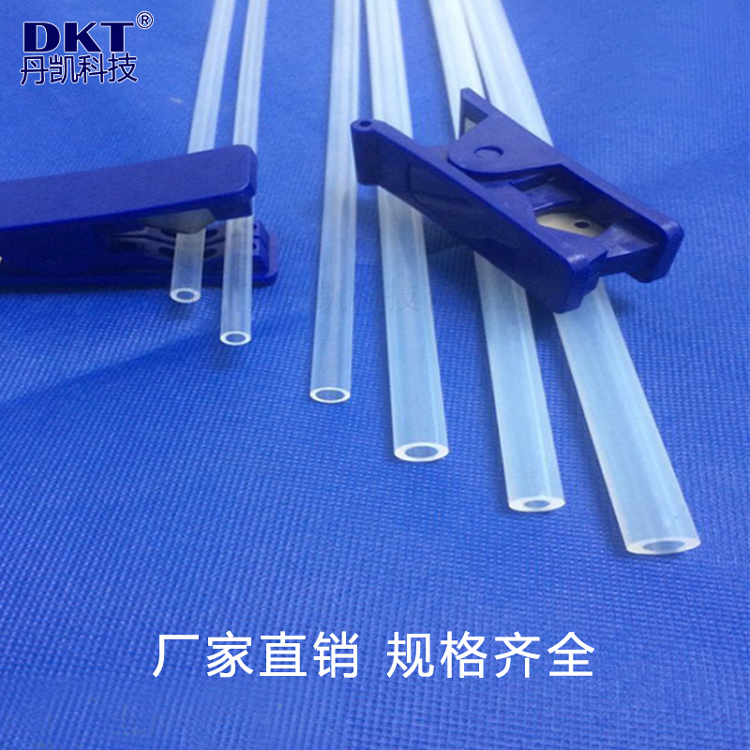
The appearance of PFA digestion tube is translucent, and it also has many excellent properties, such as high and low temperature resistance, corrosion resistance, insulation resistance, pollution prevention and so on. The appearance is translucent. Due to the extremely low dissolution and precipitation of PFA materials, it can be an ideal choice for storing standard substances and strong corrosive substances;

Figure 1:PFA tube Source: Shenzhen Dankai
It seems that both PFA tube and PTFE tube have their own unique properties, prompting them to play a role in various fields. The application of the two is not in conflict and can even make up for each other.
2. PFA film it is made of polyethylene glycol propylene resin extrusion blow molding, with excellent resistance to high, low temperature, chemical corrosion resistance, high insulation, non-stick and light transmission and other characteristics. It can be used for a long time in the range of -80~200 ℃. High and low temperature resistance, high temperature than F4 up to two times, with non-stick, high insulation, can be exposed to ozone, sunlight for a long time.
Use:
Mainly used for insulation of electrical components and wires at various frequencies.
Suitable for all kinds of bad working conditions of the place. Such as: anti-corrosion, anti-sticking, explosion-proof, sight glass, can also be used for high temperature bonding of specific materials.
Tetrafluoroethylene and perfluoropropyl vinyl ether copolymer (PFA), also known as soluble polytetrafluoroethylene, completely maintains the excellent performance of polytetrafluoroethylene, the use temperature -180 ∽ 260 ℃, has good mechanical and electrical insulation properties, outstanding heat resistance and low friction coefficient, flame retardant, low smoke, weather resistance, and good thermoplastic.
Overview:
Soluble polytetrafluoroethylene sheet and film (PFA film) are made of tetrafluoroethylene and perfluoropropyl vinyl ether copolymer resin by extrusion or blow molding. They are mainly used for various anti-corrosion, sealing, insulation, anti-adhesion, high temperature resistance, oil resistance, non-combustion and other spare parts. At the same time, it is also used as wire insulation layer for electrical and electronic industries, high frequency and ultra high frequency insulators, and electrical insulation zero parts.
Features:
1. Appearance: smooth, transparent and flat surface
2. Physical and mechanical properties

Figure 2: Thin film (PFA film) Source: Shenzhen Dankai
FEP crystalline melting point of 580F, density of 2.15g/cc (grams/cubic centimeter), it is a soft plastic, its tensile strength, wear resistance, creep resistance is lower than many engineering plastics. It is chemically inert and has a low dielectric constant (2.1) over a wide range of temperatures and frequencies. The material does not ignite and can prevent the spread of flame. It has excellent weather resistance and low friction coefficient, which can be used from low temperature to 392F. The material can be made into granular products for extrusion and molding, as powders for fluidized beds and electrostatic finishes, and also into aqueous dispersions. Semi-finished products are films, plates, rods and single fibers. Its main use is for the production of pipe and chemical equipment lining, drum surface and a variety of wires and cables, such as aircraft hook line, pressurized cable, alarm cable, flat cable and oil well logging cable. FEP films have been used as thin coatings for solar collectors. FEP or F46 is a copolymer of tetrafluoroethylene and hexafluoropropylene. The content of hexafluoropropylene is about 15%, and it is a modified material of polytetrafluoroethylene. F-46 resin has both the characteristics similar to polytetrafluoroethylene and the good processability of thermoplastics. Therefore, it makes up for the difficulty of processing polytetrafluoroethylene and makes it a material to replace polytetrafluoroethylene. It is widely used in the production of wires and cables for electronic equipment transmission wires used at high temperature and high frequency, connecting wires inside electronic computers, aerospace wires and special purpose installation wires, oil pump cables and insulating layers of submersible motor winding wires. According to processing needs, F-46 can be divided into three kinds of pellets, dispersion and paint. Among them, according to the different melt index, the pellets can be used for molding, extrusion and injection molding; the dispersion liquid is used for impregnation and sintering; the paint is used for spraying, etc.
Key words:
Next Page


Dankai Technology
Address: Area B, 4th Floor, Building 1, North Yongfa Science and Technology Park, Yanchuan North, Chaoyang Road, Songgang Town, Bao'an District, Shenzhen, China
Tel: +86-755-29979617 23127719 23127819
E-mail: dkt@szdankai.com

Focus on us
Copyright©2024 All rights reserved of Shenzhen Dankai Technology Co., Ltd.