PTFE, PFA, FEP, PVDF Fluoroplastic products industry experts

What is the difference between PFA and PTFE?
Classification:
Industry dynamics
Author:
PTFE tube little sister
Source:
PTFE tube little sister
Release time:
2004-08-29
Visits:
Polytetrafluoroethylene (PTFE) and perfluoroalkoxy resin (PFA) are two kinds of fluoroplastics widely used in the world. Their properties are very similar. PFA is even called "meltable PTFE". So, what is the difference between them?
molecular structure contrast
PTFE is polymerized from monomer tetrafluoroethylene. DuPont first discovered it in 1938. The most well-known PTFE brand is Teflon®. The following figure shows the structural formula of PTFE, and the yellow balls represent fluorine atoms.

PFA incorporates perfluoroalkoxy groups, corresponding to the substitution of one fluorine atom in PTFE with perfluoroalkoxy groups. Like PTFE, the formula of PFA was first invented by DuPont, and the most famous PFA formula is Teflon PFA. From the molecular structure, the carbon chain of PFA is relatively short, and the degree of chain entanglement is higher. The structural formula of PFA is shown in the following figure.

Performance comparison
Overall, the properties of PFA and PTFE are very similar, their biggest difference is that PFA can be melt-processed, and PTFE can not. This means that PFA can be processed using conventional injection molding and screw extrusion techniques.
PTFE solid is hydrophobic, so it is not easily affected by moisture, and the coefficient of friction is very low; PFA is more easily affected by the alternating wet and dry environment, but in terms of salt spray corrosion resistance, PFA performance is better than PTFE.
PFA has better elasticity than PTFE, especially in pipeline applications, but its resistance to repeated folding is slightly inferior to PTFE.
The dielectric constant of PFA is the same as that of PTFE, and the dissipation factor is very similar, however the dielectric strength of PFA is three to four times that of PTFE.
Application field comparison
According to statistics, more than half of the world's PTFE is used to make cables: including connecting wires, coaxial cables, etc. This is because PTFE has excellent dielectric properties, especially in the high-frequency radio field. Combined with its high melting point, PTFE is a high-performance alternative to polyethylene.
Due to its extremely low coefficient of friction, it is also used to make sliding bearings, gears, skateboards, seals, gaskets, bushings, and even lubricants to reduce mechanical friction and improve energy utilization.
Due to its excellent chemical stability, PTFE is also used to make containers and pipes for the storage and transportation of reactive or corrosive chemicals. Of course, the most daily application of PTFE is the non-stick coating of non-stick pans and kitchenware models. PTFE is also shown in the following figure as a non-stick pan coated with PTFE:

PFA is usually used in laboratory equipment, especially as an important reaction or highly corrosive chemical reaction pipeline, because PFA has strong resistance to chemical corrosion, optical transparency and good flexibility, can be very good to avoid chemical pollution caused by metal ions, so it has important applications in the field of analytical chemistry.
In thermal power plants, PFA is used as a lining for heat exchangers. Because the high-temperature gas is passed through the PFA-lined device, the gas can be cooled without damaging the heat exchanger, thereby improving the energy efficiency of the entire plant.
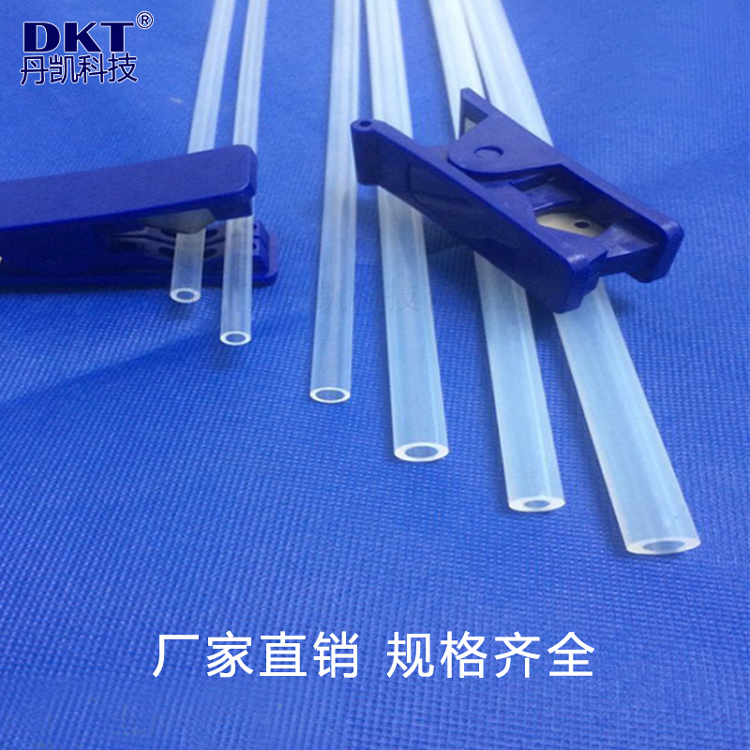
In addition, the use of PFA as a sheet lining for chemical instruments guarantees corrosion resistance, and expensive alloys and metals can be replaced by carbon steel fiber reinforced plastics (FRPs). The following figure shows the PFA tube:

For a long time in the past, PTFE has been sought after by the industrial field because of its excellent physical and chemical properties. However, the limitations of its processing methods also limit its application. PFA is actually an improved version of PTFE. Its performance is similar to that of PTFE, but it has excellent processing performance, which solves the problems of engineers.
Finally, draw a key point for students who don't like reading words. The performance comparison between PTFE and PFA is shown in the following table:

Shenzhen Dankai Technology Co., Ltd. (ShenZhen DanKai Technology Co., Ltd.), whose predecessor was the Fluoroplastic Material Factory of Dongguan Dandi Insulation Material Co., Ltd. established in 1998, specializes in the research and development, production and sales of FEP, PFA, PTFE and other fluoroplastic tube rod sheet membrane products and other insulation materials. The company has international standards of senior R & D team and the introduction of foreign fluorine plastic products production line. Some fluoroplastic products through ISO9001, SGS, FDA certification, Huawei, Foxconn, the United States, ZTE, Intel, AirTAC and other domestic and foreign cooperation customers fully affirmed. The company's main products are: ① pipes: Ptfe pipes, Fep pipes, Pfa pipes, Pvdf pipes; ② Heat shrinkable tubes: Ptfe heat shrinkable tubes, Fep heat shrinkable tubes, Pfa heat shrinkable tubes, Pvdf heat shrinkable tubes; ③ Plate rod film: Ptfe plate rod film, Feep plate rod film, Pfa plate rod film, Pvdf plate rod film, etc. PE: PE, special, spiral tube, spring tube, rotary cutting tube, welding rod, tee, straight, gasket, joint, cone rod, flared tube, sealing tube, braided tube, corrugated tube, etc. At the same time can be customized according to customer requirements processing production of various specifications of fluorine plastic products.
Key words:
Next Page


Dankai Technology
Address: Area B, 4th Floor, Building 1, North Yongfa Science and Technology Park, Yanchuan North, Chaoyang Road, Songgang Town, Bao'an District, Shenzhen, China
Tel: +86-755-29979617 23127719 23127819
E-mail: dkt@szdankai.com

Focus on us
Copyright©2024 All rights reserved of Shenzhen Dankai Technology Co., Ltd.