PTFE, PFA, FEP, PVDF Fluoroplastic products industry experts

PTFE pipe introduction
Classification:
Industry dynamics
Author:
PFA tube little sister
Source:
Dankai
Release time:
2022-12-01
Visits:
The forming process of PTFE pipe has pushing method, extrusion method, hydraulic method, welding method, winding method, etc., of which pushing method is the main method. Generally, dispersed PTFE resin is used, with a particle size of 500μm and an apparent density
0.45 g/ml ~ 0.55 g/ml. Small diameter pipe selection of compression is relatively large resin, large diameter pipe selection of compression is relatively small resin. 200 and 260 solvent oils are usually selected as extrusion aids. PTFE tubing
PTFE heat shrinkable tube, PTFE spiral tube, PTFE steel wire reinforced hydraulic tube, etc. can be produced by secondary processing.
1.1, PTFE ordinary tube
PTFE ordinary tube is made of PTFE dispersion resin at room temperature with organic solvent as additives, and then dried and sintered. According to the size of the pipe diameter can be divided into two kinds of ordinary tube and micro tube.
Ordinary tube inner diameter> 4mm, microtube inner diameter ≤ 4mm.
Typical formula for producing PTFE tube:
Dispersed PTFE resin: 100 (parts by weight)
Auxiliary agent: 18~24
Production process:
PTFE, extrusion aid → mixing → pushing → drying → sintering → cooling → products.
Production process parameters:
Mixing: temperature ≤ 19 ℃, time 10min ~ 20min, after mixing, place at 25 ℃ ~ 30 ℃ for more than 24h.
Blank preparation: the compression rate is about 50 mm/min, and the pressure is 0 ~ 3MPa.
Push: the temperature of the material cavity is 30 ℃ ~ 50 ℃, and the temperature of the die is 50 ℃ ~ 60 ℃. The push rate decreases with the increase of the pipe diameter and accelerates with the decrease of the wall thickness.
Drying: below 210 ℃, 2h ~ 3h
Sintering: intermittent sintering, heating rate 60 ℃/ h ,375 ℃ ± 5 ℃ insulation 4h.
Continuous sintering, drying zone 100 ℃ ~ 250 ℃, preheating zone 250 ℃ ~ 330 ℃, sintering zone 380 ℃ ~ 420 ℃, cooling zone less than 300 ℃.
Main equipment: mixer, preforming machine, vertical push press, drying and sintering furnace.
Uses: as insulation and transport fluid conduit, etc.

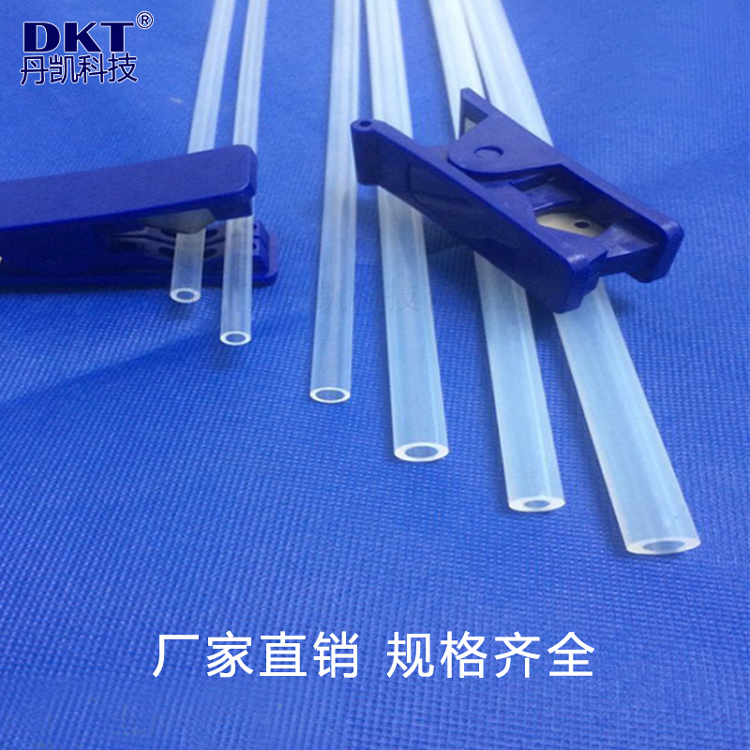
Figure 1: PTFE tube Source: Dan Kai
1.2, PTFE heat shrinkable tube
PTFE heat shrinkable tube has the characteristics of heat shrinkage, so it can be tightly wrapped in the appearance of other workpieces, so that the workpiece has corrosion resistance, electrical insulation and anti-sticking. Widely used in electrical, chemical, mechanical,
Printing and other industries. It is reported that the maximum shrinkage rate of PTFE heat shrinkable tube is greater than 75%.
It is made of dispersed PTFE resin. The principle is that PTFE is subjected to stress during processing to produce forced high-elastic deformation. This deformation is reversible and freezes at low temperature. If the frozen strength is reheated
The forced bullet deformation will gradually disappear and return to its original state.
Production of PTFE heat shrinkable tube typical formula:
Dispersed PTFE resin 100 (parts by weight)
Extrusion aid 20~22
Production process:
PTFE resin, extrusion aid → mixing → storage → preforming → pushing → drying → sintering → cooling → heat treatment → blowing → cooling → product.
Production process parameters:
The front part is the same as the ordinary PTFE tube.
Heat treatment: the dry and sintered tube is further fully sintered at high temperature and then quenched, the temperature is 390 ℃ ± 2 ℃, and the coolant is -5 ℃.
Inflation: at about 310 ℃, fill compressed gas below 0198MPa, and the inflation rate is 200~400.
Main equipment: blowing machine, other and ordinary PTFE tube the same.

Figure 2: PTFE Tube Source: Dankai
1.3. PTFE steel wire reinforced hydraulic pipe
Ordinary PTFE tube to withstand the pressure of about 40kg/ cm2 will be broken, when it is combined with the steel wire, the pressure resistance is greatly improved, the maximum working pressure abroad reaches 700kg/ cm2. Studies have shown that the hose
The compressive strength and pulse strength are not only related to the strength of the steel wire, but also to the size of the braiding angle. When the braiding angle is 54 ° 44 ″ in single-layer braiding, the steel wire is not elongated under internal pressure, and the length and straightness of the hose are not stretched.
The diameter does not change, and the pressure resistance is the best.
When used as a hose for hydraulic systems in the aviation industry, in order to prevent electrostatic breakdown of the inner tube due to the flow of hydraulic oil, a trace amount of conductive carbon black must be added to the manufacture of the PTFE inner tube. However, research hair
The addition of carbon black did not completely prevent static electricity from discharging through the tube wall and increased voids.
In the 1960 s, Attas Company manufactured a composite tube body, that is, the inner layer of the tube is a uniform mixture of a certain proportion of conductive carbon black and PTFE, and the outer layer of the tube is pure PTFE. This form of tube inner layer has
There is axial conductivity, so it can remove static electricity and prevent seepage.
Its process:
Inner layer resin (including conductive carbon black), outer layer resin → compacting → pushing → drying → cooling → inspection → weaving → fitting joint → inspection.
PTFE steel wire composite hose is mainly used in the hydraulic system, air-conditioning system, fuel system, oil system on the aircraft. In the civil industry, suitable for rubber, plastics, pharmaceuticals, clothing, shipbuilding, steam
Vehicles, machine tools, motors, diesel engines, paper and other industries for hydraulic, steam pressure, steam delivery and other soft connectors.
1.4, PTFE spiral tube
PTFE spiral pipe, also known as PTFE flexible hose, in addition to all the excellent properties of PTFE, but also has the characteristics of flexibility. At present, there are pure PTFE spiral pipes and chemical fibers and stainless steel outside the pipes.
Steel wire and plastic coated glass fiber braided reinforced two categories.
It is made of PTFE as a whole by secondary processing, the process is the PTFE thin-walled tube at a certain speed continuously through a temperature of 270 ℃ ~ 280 ℃ combined mold continuous forward rotation movement and made.
Mainly used for high temperature corrosion resistance and high temperature resistance equipment soft connection dislocation connection, serpentine pipe, pump engine and other shock parts of the inlet and outlet pipe. Shielded cables and protective cable sleeves for aircraft engines
tube, etc.
This article is originally created by Teflon's little sister. Welcome to pay attention and take you to grow knowledge together!
Key words:
Ptfe, resin, hydraulic, push, welding, extrusion, winding, corrosion resistance, electrical insulation, anti-sticking
Previous Page
Next Page
Previous Page
Next Page


Dankai Technology
Address: Area B, 4th Floor, Building 1, North Yongfa Science and Technology Park, Yanchuan North, Chaoyang Road, Songgang Town, Bao'an District, Shenzhen, China
Tel: +86-755-29979617 23127719 23127819
E-mail: dkt@szdankai.com

Focus on us
Copyright©2024 All rights reserved of Shenzhen Dankai Technology Co., Ltd.