PTFE, PFA, FEP, PVDF Fluoroplastic products industry experts

Introduction of Polytetrafluoroethylene (PTFE)
Classification:
Industry dynamics
Author:
PFA tube little sister
Source:
Dankai
Release time:
2022-12-05
Visits:
Among the varieties of fluoroplastics, the largest yield and the most widely used is polytetrafluoroethylene. Its dosage accounts for 70% to 80% of the total amount of fluoroplastics in the world. A series of properties of PTFE are better than other polymers
material, with excellent comprehensive performance. This paper introduces the structure of PTFE, based on the analysis of molecular structure, expounds its physical and chemical characteristics, and summarizes
application, and the application prospect of the material is prospected.
Polytetrafluoroethylene (Polytetrafluoro ethylene,PTFE), referred to as F4, trade name is "Teflon" (Teflon), commonly known as "plastic king". 1938, New Jersey DuPont Research
Dr. R. S. Plunkett of the laboratory first invented polytetrafluoroethylene. DuPont registered Teflon in 1945.®(Teflon®) trademark, realized the industrialization of polytetrafluoroethylene in 1948
Production. Tetrafluoroethylene under atmospheric pressure is a colorless odorless gas, boiling point -76.3 ℃, melting point -142.5 ℃, explosive, easy to self polymerization. PTFE is a highly crystalline polymer of tetrafluoroethylene (TFE) monomer, white, free
Poison, tasteless. Its polymer molecules are made of-(-CF2-CF2-)-structural units repeatedly connected, and it is the latest type of engineering plastics used in various industries.
1. Structure and characteristics of PTFE
In PTFE, fluorine atoms replace hydrogen atoms in polyethylene. Because the larger radius of fluorine atoms is (0.064nm), which is larger than the radius of hydrogen atoms (0.028nm), and the negative of fluorine atoms in adjacent macromolecules
The charges repel each other, making the C- C chain gradually twist from the planar and fully extended tortuous conformation of polyethylene to the helical conformation of PTFE, and form a tight and completely "fluorinated" protective layer,
This gives it a chemical stability unmatched by other materials and a low cohesive energy density.
The bond energy of the C- C bond is 372kJ/mol, and the bond energy of the C- F bond is 347kJ/mol, which is strong among the known bond energies, and therefore the intramolecular bonding is strong and the heat resistance is high. Long-term use temperature is -250 ℃ ~ 260 ℃,
The bond length of the C- C bond is 1.54 × 10⁻¹⁰m, and the bond length of the C- F bond is 1.41 × 10⁻¹⁰m, which is the shorter of the common single bonds, so the chemical properties are stable and it is difficult to react with other substances.
Excellent weather resistance, stain resistance and chemical resistance were shown.
There is no branched chain on the main chain of the macromolecule, and no cross chain is formed in the whole, so its molecular contour is smooth. In addition, TFE monomer has perfect symmetry, which makes the attraction and surface energy between PTFE molecules low, so
PTFE has a very low surface friction coefficient and is easily transferred to the opposite surface during sliding to form a thin transfer film.
2. The composition and structure of PTFE determine its performance as follows
2.1 mechanical properties
2.1.1 Stress-strain performance
Under the action of stress, there are two types of distortion modes in the crystalline band of polytetrafluoroethylene. The first type of distortion occurs under low stress. When the elongation is small, the stripes are separated from the band axis for lateral sliding.
The rotation in the force direction, some stripes become oblique, this distortion belongs to the non-crystalline distortion; At very low temperature, the non-crystalline region is frozen, and such distortion does not occur. The second type of distortion occurs at high stress
The stripes point to the stress direction and distort the human glyph, which belongs to the actual strain of the crystal. Rapid cooling of polytetrafluoroethylene due to the small size of the crystalline band, the first type of distortion occurs in many cases, due
This has higher strength and elongation.
2.1.2 Creep and stress relaxation
The creep and stress relaxation properties of PTFE are not only related to temperature, time and load, but also related to crystallinity and molecular weight. The crystallinity corresponding to the optimum rigidity of polytetrafluoroethylene
Above this crystallinity, the creep resistance of PTFE decreases with increasing crystallinity, and the increase in creep may be related to the presence of shorter polymer chains.
2.1.3 Cold stretching behavior
Near room temperature, low crystallinity of PTFE in cold stretching than high crystallinity of the hard, indicating that the crystalline region of PTFE is plastic, so easy to yield under stress, and in the amorphous region
The molecular chains are aligned and oriented in the direction of stress, and very small crystallites can also be oriented in this way, so that they can easily harden and prevent plastic deformation.
2.1.4 Fatigue behavior
PTFE can be repeatedly damaged by fatigue, but still maintain physical integrity and maintain a residual fatigue strength.
2.2 thermal performance
PTFE has excellent heat resistance and cold resistance, long-term use temperature range is very wide (-195~250 ℃), at 250 ℃ high temperature after 240h aging, its mechanical properties basically unchanged. poly four
The glass transition temperature of vinyl fluoride is about 115 degrees C, the crystalline melting point is 327 degrees C, heated to above the melting point is still no viscous flow transition, the temperature rises to 390 degrees C began to decompose. The thermal conductivity of PTFE is
0.20-0.25W/m • K. The linear expansion coefficient is between (10-15)× 10-5m/(m · K), which is larger than most plastics, 10-20 times that of steel, and increases with the increase of temperature.
2.3 electrical properties
PTFE is a highly non-polar material with excellent electrical properties and is not affected by temperature, humidity and frequency. The fluorine atoms on the polytetrafluoroethylene molecular chain are symmetrical, carbon-fluorine
The bond is very strong, so there is no free electron in the molecule, and the whole PTFE molecule is electrically neutral. The electrical properties at room temperature are shown in Table 1. Above 0 degrees C, its dielectric constant is not.
varies with temperature and frequency. With the increase of temperature, the volume resistivity of PTFE changes slightly, even at 220 ℃, there is still a high volume resistivity.
2.4 resistance to chemicals and solvents
The bond energy of the C- F bond in polytetrafluoroethylene is high and stable, and the molecule has a spiral configuration, C- C the main chain is completely shielded by bulky fluorine atoms. Therefore, concentrated acid, strong alkali, strong oxidant even at high temperatures
Nor does it work on Teflon. The chemical resistance of PTFE even exceeds that of precious metals. In addition to perfluoroalkanes and perfluorochloroalkanes, polytetrafluoroethylene has a slight swelling phenomenon, ketones,
Ethers and other organic solvents can not work on it. At present, it is found that only molten alkali metals, chlorine trifluoride and fluorine elements can act on it, but only under high temperature and high pressure.
Obviously. Because the wettability of polytetrafluoroethylene is very small, its absorption rate of acid and solvent is very low, and long-term contact at high temperature generally increases by only about 1%. However, since PTFE cannot be melted
Melt processing, containing pores in the product, is conducive to the penetration of the solvent, the smaller the pre-forming pressure, the more pores, the greater the penetration.
2.5 radiation resistance
For PTFE, the F atom has a larger atomic radius and the largest electronegativity, so the PTFE molecular chain is a helical rigid chain. Irradiation under the usual conditions, the resulting different macromolecular chains
It is difficult to form a cross-linked structure between free radicals, so that the degradation reaction becomes the main reaction. After receiving radiation energy, PTFE is fractured at the C- C site to generate two macromolecular free radicals, rarely at C ~
Fractured part F. The free radicals formed have high stability and can achieve reactions such as structural rearrangement or intermolecular disproportionation near the breaking point.
The cleaved end rapidly stabilizes, and finally a random, small molecular weight distribution polymer is obtained. Therefore, the radiation degradation of PTFE belongs to the free radical degradation mechanism. Under the action of radiation, the molecular weight of PTFE decreases rapidly,
The performance changes a lot. The degradation of PTFE is affected by irradiation conditions, and different high-value degradation products can be obtained under different irradiation conditions. In oxygen radiation degradation can be obtained high fluoride acid derivatives, in
Perfluoroalkenes and perfluoroalkanes can be obtained by irradiation in inert gas; pure PTFE or modified PTFE ultrafine powder can be obtained by radiation degradation in the air or in the atmosphere where the ratio of oxygen and nitrogen is adjusted.
2.6 non-stick
PTFE has a spiral structure, so the molecules are more rigid, the attraction between the molecules is very weak, so the molecules are easy to slide. The friction factor is one of the lowest in plastics, and the dynamic and static friction factors are more connected.
Near. For example, the dynamic and static friction factor of steel can be as low as 0.04, and its own friction factor can be as low as 0.01, close to ice. For a filter material made of 100 % PTFE fiber, its frictional
The number is low, and the energy consumption can be reduced when the filter material is cleared.

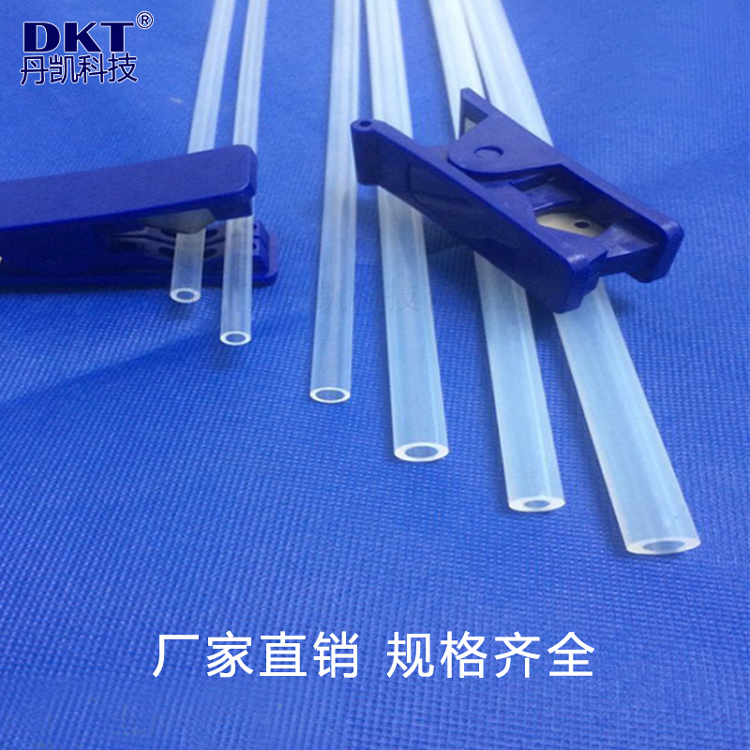
Figure 1: PTFE tube Source: Dan Kai
3. Application of PTFE
PTFE has excellent high and low temperature performance and chemical stability, good electrical insulation, non-stick, weather resistance, non-flammable and good lubricity, application from the aerospace field to daily commodities, has become a modern
Science and technology, military and civilian to solve many key technical problems indispensable materials.
Application of Anti-corrosion and Anti-wear of 3.1
PTFE material overcomes the corrosion resistance of ordinary plastics, metals, graphite, ceramics, etc., and has poor flexibility. With its excellent high and low temperature resistance and corrosion resistance, it can be used under harsh conditions of temperature and pressure.
It has become the main corrosion-resistant material in petroleum, chemical, textile and other industries.
PTFE pipe is mainly used as a corrosive gas, liquid, steam or chemical delivery pipe, exhaust pipe. The push pipe molded by PTFE dispersion resin is lined into the steel pipe to form a lining, or the PTFE push inner pipe is lined.
The outer winding of glass fiber reinforcement, or in the PTFE push tube external steel wire braided winding reinforcement can be transferred under high pressure liquid medium, as an indispensable part of hydraulic transmission, and can greatly improve the high temperature
At the same time, it has good bending fatigue. Because the coefficient of friction of PTFE material is the lowest known solid materials, this makes filled PTFE material oil-free mechanical equipment parts.
The most ideal material for lubrication. For example, the equipment in the field of papermaking, textile, food and other industrial fields is easy to make the product contaminated, filled with PTFE material to solve this problem. In addition, the experiment proved that the machine
Adding a certain amount of solid additives to the oil can effectively save about 5% of the engine fuel oil.
Application of 3.2 corrosion-resistant sealing materials
Due to the good comprehensive performance of PTFE, it is unmatched by any kind of sealing material. It can be used for sealing in various harsh occasions, especially when high temperature and corrosion resistance are required. Teflon
The ethylene raw material belt has long fiber length, high strength, large plasticity and good rolling ductility. It can be completely sealed by applying a small pressing force. It is convenient to operate and apply. It is more efficient when used on uneven or structurally precise surfaces.
It has good sealing performance and can improve corrosion resistance and expand its scope of use. The sealing of sliding parts uses PTFE packing, which can obtain good corrosion resistance and stability, and it has certain
Compression resilience, sliding resistance is small. PTFE-filled sealing materials are used in a wide range of temperatures and are currently the main substitute for traditional asbestos gasket materials,
Fatigue resistance, as well as high thermal conductivity, thermal expansion coefficient and friction coefficient of small performance, adding different fillers can expand the scope of application.
3.3 anti-sticking applications
PTFE material has the smallest surface tension in solid materials, does not adhere to any substances, and also has excellent characteristics of high and low temperature resistance and non-toxicity. Therefore, PTFE is often used as a coating for anti-sticking lining of tableware.
To be used in the liner of non-stick pans and microwave ovens. Although PTFE material has excellent properties that other materials cannot replace, it also has certain disadvantages, such as difficult to melt processability, difficult to weld and cold.
Flow. With the continuous development of material application technology, these shortcomings are gradually being overcome, so that it has a broader application prospect in petrochemical, electronics, medicine, optics and other fields.
3.4 electrical applications
PTFE has excellent electrical properties, its volume resistivity of up to 1017, surface resistivity of greater than 1016, in 100% relative humidity also remains unchanged;
It is 2 × 10⁻⁴ and has nothing to do with temperature and frequency. Good heat resistance, long-term use at 260 ℃, good insulation, can reach grade H or above; It has strong toughness and flexibility, even if it is as low as -90 ℃, the toughness is still not affected. Resistance
Aging, excellent weather resistance, high chemical stability; non-flammable and low smoke. The printed circuit substrate made of it has been widely used in the field of aerospace, so PTFE products are particularly suitable for electrical
computer, test and measurement, defense and many other high-performance, high-challenge areas.
Application of 3.5 Architecture
The first building to use PTFE as a material was built in California in the 1970 s. In the past two years, it has also been used in China, such as: Beijing Olympic Bird's Nest, Shanghai Railway Station North Square Station, Shanghai World
Expo Norway Pavilion, etc. PTFE as a building membrane material durable years in more than 20 years, and its self-cleaning is good, does not absorb dust and dirt, rain can wash off the surface of the attachment, can reduce the cost of cleaning,.
Suitable for high cleanliness requirements of the occasion.
3.6 medical and health applications
PTFE surface tension is small, non-hydrophilic, good biocompatibility, can be used for artificial blood vessels, the increase of the potential energy of the inner surface of the artificial blood vessel wall will promote the settlement and coagulation of endothelial cells, which is microporous PTFE products.
The change of surface energy leads to obvious biological reaction results of surrounding tissues, and this property can be used to prevent the thrombosis process in the gap of the graft. The gastroscope clamp guide is composed of expanded PTFE and rubber plastic film.
The tube can be bent and deformed at will, and has no foreign body reaction in contact with the human body. It is used for instant sampling of the human stomach, taking foreign bodies, removing polyps, etc. It can be operated freely and prevent unnecessary pain of the patient. Another
PolyPTFE can be made into artificial cruciate ligament, joint, esophagus and trachea, urethra, bile duct, etc. The more common cosmetic surgery rhinoplasty and mandibular surgery are also filled with PTFE
material.
With the continuous development of material application technology, in recent years, foreign research on the application of PTFE and its modified materials has made it a very mature material.
There is still a big gap between processing and molding technology and foreign countries. PTFE has excellent performance in many aspects, is unmatched by other materials, the application field is very broad.
This article is originally created by Teflon's little sister. Welcome to pay attention and take you to grow knowledge together!
Key words:
Ptfe, polytetrafluoroethylene, material, has, weather resistance, stain resistance, chemical resistance, radiation resistance, high temperature resistance, electrical insulation, lubricity, sealing, performance
Previous Page


Dankai Technology
Address: Area B, 4th Floor, Building 1, North Yongfa Science and Technology Park, Yanchuan North, Chaoyang Road, Songgang Town, Bao'an District, Shenzhen, China
Tel: +86-755-29979617 23127719 23127819
E-mail: dkt@szdankai.com

Focus on us
Copyright©2024 All rights reserved of Shenzhen Dankai Technology Co., Ltd.