PTFE, PFA, FEP, PVDF Fluoroplastic products industry experts

What are the properties of polytetrafluoroethylene?
Classification:
Industry dynamics
Author:
PFA tube little sister
Source:
Dankai
Release time:
2022-12-06
Visits:
The mechanical properties of polytetrafluoroethylene are relatively soft. It has a very low surface energy. PTFE has a series of excellent performance:
1. High temperature resistance: long-term use temperature 200~260 degrees;
2, low temperature resistance: still soft at -100 degrees;
3, corrosion resistance: able to aqua regia and all organic solvents;
4, weather resistance: the best aging life in plastics;
5, high lubrication: with the smallest coefficient of friction in plastic (0.04);
6, non-sticky: has the smallest surface tension in solid materials and does not adhere to any substance;
7. Non-toxic: physiologically inert; Excellent electrical performance, is an ideal C- class insulation material, a thick layer of newspaper can block 1500V high voltage; Smooth than ice.

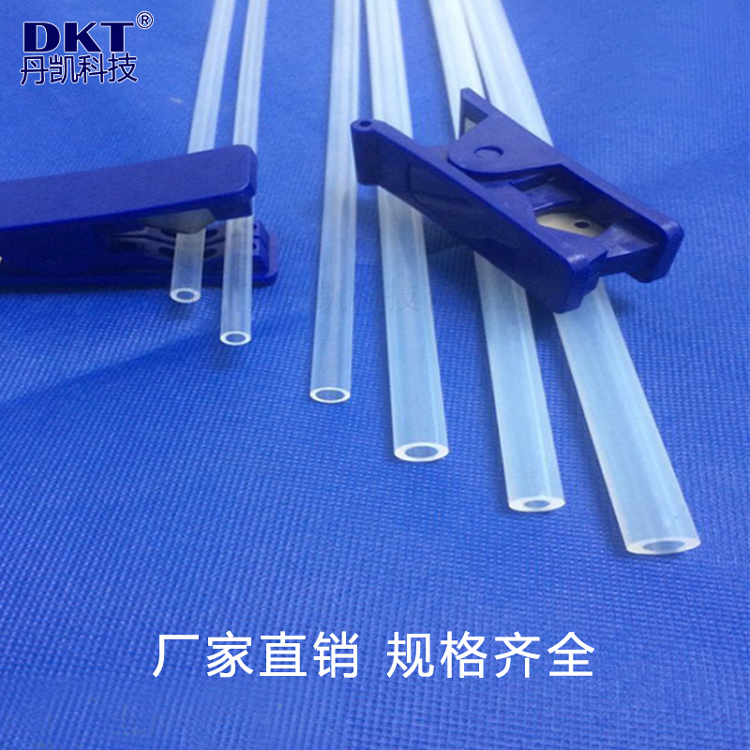
Figure 1: PTFE tube Source: Dankai
The coefficient of friction of polytetrafluoroethylene is extremely small, only 1/5 of that of polyethylene, which is an important feature of perfluorocarbon surfaces. And because of the fluorine-carbon chain intermolecular force is very low, so the polytetrafluoroethylene has no viscosity.
PTFE maintains excellent mechanical properties in a wide temperature range of -196~260 ℃, and one of the characteristics of perfluorocarbon polymers is that they are not brittle at low temperatures. PTFE is denser and is 2.14-
2.20 g/cm, almost no water absorption, the equilibrium water absorption rate is less than 0.01%. Teflon is a typical soft and weak polymer, the mutual attraction between macromolecules is small, stiffness, hardness, strength are small, in
Deformation under long-term stress.
Polytetrafluoroethylene is prone to creep when loaded and is a typical plastic with cold flow properties. The creep of PTFE varies with compressive stress, temperature, and crystallinity, with the higher the temperature, the greater the creep.
The crystallinity of PTFE is between 55% and 80%, and the creep amount does not exceed 2%; when the crystallinity is below 55% and above 80%, the creep amount increases rapidly. Excellent mechanical properties of PTFE
Is the friction factor is small, between 0.01-0.10, in the existing plastic materials, and even all engineering materials in the smallest.
The friction factor of PTFE increases with the increase of sliding rate, and becomes stable when the line speed reaches more than 0.5-1.0 m/s, and the static friction factor is less than the dynamic friction factor, which is used for bearing system.
It can reduce its starting resistance and make it very stable from starting to running. The friction coefficient of PTFE decreases with the increase of load, and tends to be constant when the load reaches above 0.8MPa. At high speed, high
Under load, the friction coefficient of PTFE is lower than 0.01. From the ultra-low temperature to the melting point of PTFE, the friction coefficient is almost unchanged, only when the surface temperature is higher than the melting point, the friction coefficient increases sharply. Due to molecular
The attraction is small, the hardness of PTFE is low, and it is easy to be worn by other materials. However, as long as the surface roughness of the grinding material is appropriate, the wear amount of PTEF can be reduced to a considerable extent.
PTFE has a high resistance to chemical corrosion, such as in concentrated sulfuric acid, nitric acid, hydrochloric acid, and even in the aqua regia boiling, its weight and performance are unchanged, but also almost insoluble in the vast majority of dissolved
The agent is only slightly soluble in all alkanes (about 0.1g/100g) above 300 ℃. PTFE does not absorb moisture, non-flammable, oxygen, ultraviolet are extremely stable, so it has excellent weather resistance. noteworthy
Yes, polytetrafluoroethylene cannot withstand molten alkali metals in a strong reducing atmosphere, ammonia alkali solution (alkali metals are dissolved in liquid ammonia), some fluorides (such as TFA), naphthalene sodium salt, etc. can rapidly corrode polytetrafluoroethylene
Vinyl products. PTFE has low dielectric constant and dielectric loss over a wide frequency range, and high breakdown voltage, volume resistivity and arc resistance.
The radiation resistance of PTFE is poor, and the degradation caused by high-energy radiation, the electrical and mechanical properties of the polymer are significantly reduced. Polytetrafluoroethylene is produced by radical polymerization of tetrafluoroethylene.
Industrial polymerization is carried out with stirring in the presence of a large amount of water to disperse the heat of reaction and to facilitate temperature control. Polymerization is generally carried out at 40~80 ℃,3~26 kgf/cm pressure, which can be
Inorganic persulfates and organic peroxides are used as initiators, and redox initiation systems can also be used. The exotherm was 171.38kJ per mole of tetrafluoroethylene polymerized. Dispersion polymerization must be added to the surface of the perfluorinated type
Active agents, such as perfluorooctanoic acid or salts thereof.
This article is originally created by Teflon's little sister. Welcome to pay attention and take you to grow knowledge together!
Key words:
PTFE, with, friction, material, high and low temperature resistance, corrosion resistance, weather resistance, high lubrication, non-stick,,Small friction coefficient, performance
Previous Page
Previous Page


Dankai Technology
Address: Area B, 4th Floor, Building 1, North Yongfa Science and Technology Park, Yanchuan North, Chaoyang Road, Songgang Town, Bao'an District, Shenzhen, China
Tel: +86-755-29979617 23127719 23127819
E-mail: dkt@szdankai.com

Focus on us
Copyright©2024 All rights reserved of Shenzhen Dankai Technology Co., Ltd.