PTFE, PFA, FEP, PVDF Fluoroplastic products industry experts

Polytetrafluoroethylene molding method-molding method
Classification:
Industry dynamics
Author:
PFA tube little sister
Source:
Dankai
Release time:
2022-12-13
Visits:
1. molding method
The molding method is one of the most common PTFE molding methods. We generally call it molding, or pressing molding, compression molding. Powder (compression molding powder), powder
Granular or fibrous plastic raw materials are added to the forming mold to soften and deform by heating, fill the mold under pressure, close the mold and pressurize it to form and solidify the plastic products.
As the most ancient molding method, the advantages of molding method are obvious: small loss of raw materials, stable deformation performance, low cost of molding mold, good reusability,
High production efficiency, automatic production, etc.
Black is white, its shortcomings are also difficult to avoid, low dimensional accuracy, products after molding labor is larger, mold demand is large, mold filling has certain technical requirements.
PTFE molding process can be divided into the following 12 kinds according to the state of the reinforced material and the variety of the molding material:
(1) fiber material molding method.
(2) broken cloth molding method.
(3) fabric molding method.
(4) Lamination molding method.
(5) winding molding method.
(6) sheet plastic molding method.
(7) Pre-forming billet molding method.
(8) Directional auxiliary molding.
(9) molding powder molding method.
(10) Adsorption preform molding method.
(11) the mass molding method.
(12) felt molding method.
The resin used in the synthesis of PTFE molded products requires: ① good wetting properties for reinforcing materials, so as to form good properties on the interface between synthetic resin and reinforcing materials.
Bonding; ② have proper viscosity and good fluidity, and can evenly fill the entire mold cavity with reinforcing materials under pressing conditions; ③ have suitable under pressing conditions.
The curing speed, and the curing process does not produce by-products or by-products, the volume shrinkage rate is small; ④ can meet the specific performance requirements of molded products. According to the above material selection
The commonly used synthetic resins are: unsaturated polyester resin, vinyl resin, silicone resin, polybutadiene resin, allyl ester, melamine resin, polyimide tree
Fat, etc. In order to make the molded products to achieve specific performance indicators, after the selection of resin varieties and grades, should also choose the corresponding auxiliary materials, fillers and pigments.

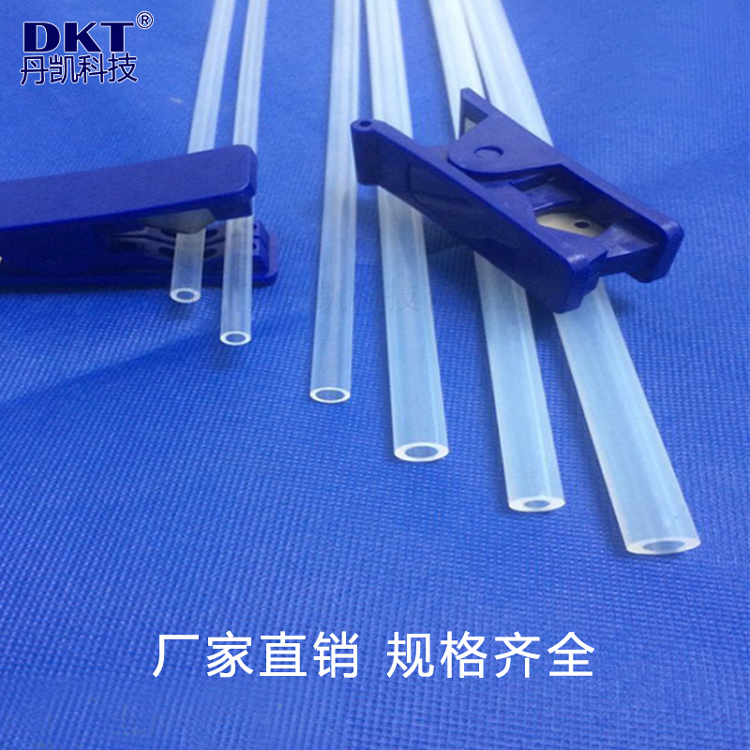
Figure 1: PTFE tube Source: Dankai
Creep properties in the modification of 2. polytetrafluoroethylene filling
PTFE PTFE has heat resistance, cold resistance, chemical resistance and excellent weather resistance, and has special electrical properties, surface characteristics, non-stick, self-lubricating and low friction.
friction coefficient and other characteristics, has been widely used in national defense, military, aerospace, automotive, petrochemical and many other fields. Although PTFE has the above unique excellent properties,
Due to the large coefficient of linear expansion, poor dimensional stability, low thermal conductivity, poor wear resistance, poor thermal conductivity, prone to local overheating, low hardness and performance under large loads
The "cold flow" phenomenon and other shortcomings, limiting its practical and functional.
PTFE as one of the largest amount of high-performance materials in aerospace materials, especially aviation sealing materials, however, due to poor creep resistance
its further application. Therefore, the study of the main factors and mechanisms affecting the creep resistance of PTFE, looking for efficient ways to improve the creep resistance, and make a reasonable
It is of great economic and social significance for the preparation of high-performance aerospace sealing materials.
According to the literature, the United States Garlock series of products and Ameri-ion series of products are more successful examples of filling modification, with good creep resistance, basically.
The use of special filling system and structural reorganization of PTFE and developed to solve the cold flow and creep problems and less impact on mechanical properties, has been successfully applied to gasket sealing and.
Gear materials.
To explore the creep behavior of PTFE, there are two aspects of work, one is to determine and evaluate the creep behavior of PTFE; the other is to improve the creep performance of PTFE. Pass
The usual practice is to determine the amount of creep deformation at a certain temperature and a certain stress level in a certain period of time, according to which the empirical formula is obtained, and the time-temperature equivalent conversion relationship is reused.
Its long-term creep performance.
Introduction of 3. PTFE corrosion resistance
PTFE is one of the fluoroplastics used for sealing, which has the characteristics of high corrosion resistance, high and low temperature resistance, and stable physical properties. Its corrosion resistance even exceeds stainless steel,
Gold, platinum, ceramics, known as "plastic king" reputation. PTFE sealing ring, PTFE film, PTFE pipe products and other products, widely good in the market
Comment.
Why is the corrosion resistance of PTFE so good? Let's look at its structure:-[-CF2-CF2-]n-. C- F covalent bond determines the superiority of its corrosion resistance, oxidation,
Some reactions such as chlorination cannot bring damage to C- F covalent bonds, because C- C covalent bonds are usually protected by C- F covalent bonds, which means that other atoms are difficult to access C- C bonds.
The electron cloud between them is repelled by the electronegativity of F atoms, so polytetrafluoroethylene does not oppose most known strong chemical reagents, strong acids, strong bases, water and various organic solvents.
Should, its corrosion resistance is self-evident.
PTFE is the main force of corrosion-resistant materials on the market, its excellent corrosion resistance has become the main corrosion-resistant materials in petroleum, chemical, textile and other industries, its specific
Applications include: pipes for transporting corrosive gases, exhaust pipes, steam pipes, high-pressure oil pipes, aircraft hydraulic systems and low-pressure pipes, rectification towers, heat exchangers, kettles, towers, tanks
Lining, valves and other chemical equipment.
Application and composition of 4. PTFE pipe
PTFE pipes are generally used for various fluid transportation and fuel pipelines with high corrosion resistance requirements. PTFE PTFE tube consists of three parts: one is PTFE dispersion
The inner tube (straight tube) pushed by resin, the second is the woven reinforcement layer of stainless steel wire or other fibers outside the inner tube of polytetrafluoroethylene, and the third is the gold buckled at both ends of the tube for connection.
It is a joint.
Generally, the inner diameter of PTFE pipe is from φ 6 to φ 50mm, the medium pressure pipe with a pressure resistance of 10.5MPa is called, and the high pressure pipe with a pressure resistance of 21MPa is called.
Teflon pipes are used to transmit corrosive liquids or gases, such as hydraulic fluids and fuel transportation in the aerospace industry; high-pressure air and fuel in the automotive industry
And hydraulic transmission; chemical industry chlorine, steam, acid and alkali organic transport; pharmaceutical industry high purity fluid transport and so on. Because PTFE has plastic
The best high and low temperature resistance, corrosion resistance, aging resistance, high insulation and non-stick, etc., so the pressure hose processed by PTFE is increasingly cutting-edge aerospace.
favored by the industrial sector.
The quality of the PTFE tube is determined by the PTFE inner tube, the braided reinforcement layer and the metal joint. Any problem in any one of them will cause the PTFE tube to flow.
The body leaks or even ruptures and fails.
This article is originally created by Teflon's little sister. Welcome to pay attention and take you to grow knowledge together!
Key words:
PTFE, molding, molding, material, has, corrosion resistance, high and low temperature resistance, aging resistance, high insulation, non-stick, characteristics
Previous Page


Dankai Technology
Address: Area B, 4th Floor, Building 1, North Yongfa Science and Technology Park, Yanchuan North, Chaoyang Road, Songgang Town, Bao'an District, Shenzhen, China
Tel: +86-755-29979617 23127719 23127819
E-mail: dkt@szdankai.com

Focus on us
Copyright©2024 All rights reserved of Shenzhen Dankai Technology Co., Ltd.