The helical conformation is just surrounded by the carbon chain skeleton of PTFE susceptible to chemical attack, forming a tight and completely "fluorinated" protective layer, so that the PTFE main chain is not subject to any external factors.
The invasion of the reagent makes PTFE have solvent resistance, chemical stability and low cohesive energy density that other materials cannot match; at the same time, the carbon-fluorine bond is extremely strong, and its bond energy can reach
460.2kJ/mol is much higher than carbon-hydrogen bond (410 kJ/mol) and carbon-carbon bond (372 kJ/mol), which makes PTFE have good thermal stability and chemical inertness.
In addition, the electronegativity of fluorine atoms is extremely large, and the tetrafluoroethylene monomer has perfect symmetry, which makes the attraction and surface energy of PTFE molecules low, so that PTFE has extremely low
Surface friction coefficient and good ductility at low temperature; at the same time, the creep resistance of PTFE is poor, and cold flow phenomenon is easy to appear. The unbranched symmetric backbone structure of PTFE also makes
It has a high degree of crystallinity, so processing is difficult.

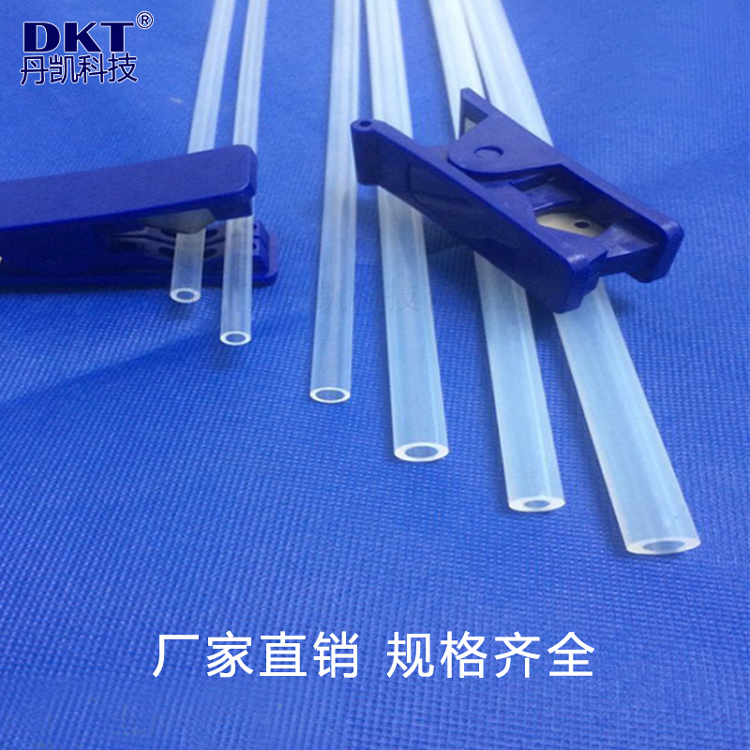
Figure 1: PTFE tube Source: Dan Kai
2. PTFE surface modification method:
2.1 reducing agent method (sodium-naphthalene solution replacement method)
Among the various known modification methods, the sodium-naphthalene solution replacement method is better and more widely used.
The principle is: Na transfers the outermost electron to the empty orbit of naphthalene, forming an anion radical; and then forms an ion pair with Na, releasing a large amount of resonance energy, generating
A mixed solution of metal organic compounds is dark green.
These compounds have high reactivity. When in contact with PTFE, sodium can destroy C- F bonds, tear off part of the fluorine atoms on the surface of PTFE, and leave a carbonized layer and-CH,-
CO, C = C,-COOH and other polar groups; The depth of the carbonized layer is about 0.05 ~ 1μm, the surface tension of PTFE is from 18.5 × 10⁻³N/m, and the surface has a high surface.
Face energy.
In addition to sodium-naphthalene tetrahydrofuran etching solution, sodium-biphenyl dioxane, sodium-naphthalene glycol dimethyl ether and other treatment solutions also have good results.
2.2 high temperature melting method
The advantage of this method is that weather resistance, moisture and heat resistance than other methods, suitable for long-term outdoor use;
The PTFE membrane shape is not easily maintained.
2.3 plasma treatment
Badey J P and others treated PTFE with microwave plasma downstream and modified its surface. PTFE treated with O2/N2 or O2 without surface modification; NN3 plasma
Treatment, the PTFE surface polar components increased, hydrophilic increased.
2.4 laser radiation method
It has many advantages in material processing, which is difficult to compare with other surface treatment technologies:
The energy transfer is convenient, and the surface of the workpiece can be selectively strengthened;
The energy is concentrated, the processing time is short, the heat affected zone is small, and the workpiece deformation is small after laser treatment;
The processing of complex surface shape of the workpiece, and easy to realize automatic production;
④ The modification effect is more significant: fast speed, high efficiency and low cost;
Usually can only deal with some sheet metal version, not suitable for dealing with thicker plates;
Due to the harm of laser to the human eye, it affects the safety of the staff, so we should devote ourselves to the development of safety facilities.
The steps of this method are as follows: the PTFE membrane is placed in styrene, fumaric acid, methacrylate and other polymerizable monomers, and Co60 radiation is used to make the monomer on the surface of the PTFE membrane.
A layer of easily adhesive graft polymer is formed. The grafted PTFE grows up evenly in the three-dimensional direction and maintains its shape, but loses its original luster and lubricating feeling. Surface roughness
It increases with the increase of the grafting amount, but the surface does not change color, and the surface resistance does not change in a humid environment.
2.5 silicic acid activation method
Porous PTFE with SiX4 treatment, and then by hydrolysis, can achieve the purpose of PTFE surface activation, this is the "silicic acid modification method".
Advantages: The traditional modification method will change the chemical structure of PTFE, thus affecting the inherent structure of PTFE to varying degrees;
structure, but also to achieve the purpose of its surface activation.
This article is originally created by Teflon's little sister. Welcome to pay attention and take you to grow knowledge together!