PTFE, PFA, FEP, PVDF Fluoroplastic products industry experts

Expanded polytetrafluoroethylene artificial blood vessel
Classification:
Industry dynamics
Author:
PFA tube little sister
Source:
Dankai
Release time:
2022-12-28
Visits:
Expanded polytetrafluoroethylene (ePTFE) is 100% polytetrafluoroethylene resin (PTFE) as raw material, using paste extrusion, stretching and other special processing methods. It is a new kind
Type medical polymer materials. It has a network structure formed by the connection of fine fibers. These fine fibers form many pores, so expanded polytetrafluoroethylene (ePTFE) can be
To bend more than 360 degrees, has good toughness, high longitudinal strength, easy deformation in the transverse direction, and improved material flexibility and blood compatibility. expanded polytetrafluoroethylene
EPTFE is an ideal medical polymer material widely used in artificial blood vessels.
Dankai polytetrafluoroethylene (PTFE) products have high temperature resistance, acid and alkali resistance, solvent resistance, excellent electrical insulation and biocompatibility. They have long been used for traditional jobs.
industries, such as chemical, mechanical and electronic fields. Expanded polytetrafluoroethylene (ePTFE) microporous membranes developed since the 1970 s have developed microporous membranes in sealing, electronics, textile,
Medical, environmental protection and other fields of application range. applications in the field of technology.
In the medical field, the incidence of vascular occlusive diseases such as arteriosclerosis is increasing. As a substitute for many severely stenosed or occluded blood vessels, artificial blood vessels have important
Clinical application value. With the rapid development of bioengineering and biomaterials, artificial blood vessels are mainly used to temporarily or permanently replace patients' arteries or veins in current operations.
defects, or as arterial obstruction in the event of a flow path and kidney disease. The patient was replaced by an arteriovenous graft required for hemodialysis. It can be seen that artificial synthetic blood vessels are used
As a substitute, especially large-caliber artificial blood vessels have been widely used in tissue repair and vascular reconstruction surgery.
The ideal synthetic vascular material should meet the following requirements: good biocompatibility, with special emphasis on excellent blood compatibility, non-immunogenicity, strong plasticity, certain strong
degree, vascular biomechanical requirements, easy cell planting. Therefore, the materials used for manufacturing artificial blood vessels can be divided into natural biological materials and synthetic materials. Natural Biomaterials Package
Including macromolecular materials, such as acellular matrix, collagen, polyamino acids, peptides, hyaluronic acid and its complexes;
alkene (PTFE) and nylon -6. However, due to the immature technical conditions of degradable materials, expanded polytetrafluoroethylene (ePTFE) due to its porous and good surface properties
energy and flexibility as a substitute for synthetic artificial blood vessels.

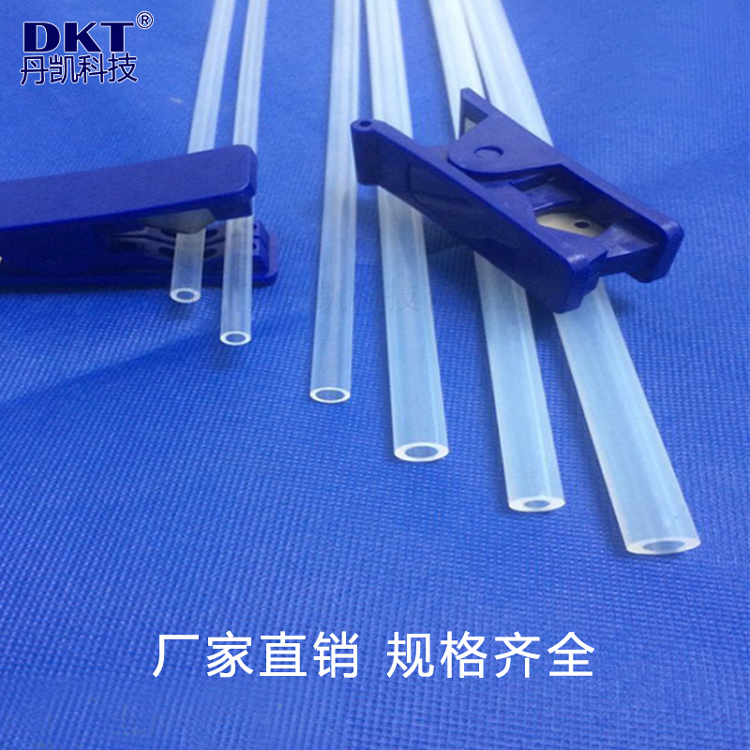
Figure 1: PTFE tube Source: Dankai
1. Preparation of expanded polytetrafluoroethylene
Expanded polytetrafluoroethylene (ePTFE) is made from polytetrafluoroethylene dispersion resin as a raw material, and a liquid propellant is added. After mixing, it is pre-pressed into blanks and placed in special facilities.
Prepare, extrude into a tube as needed. The rod product is dried to remove the extrusion aid. At this time, the tubular product can be pulled out and the rod-shaped product can be dried and stretched.
Calendering. The stretched product should be heat set in a specific temperature range, and after cooling, an expanded polytetrafluoroethylene (ePTFE) medical product can be obtained.
2. Structure and properties of expanded polytetrafluoroethylene
As we all know, PTFE is known as the "king of plastics". It is very inert, has excellent chemical stability, electrical properties, surface properties and good physical and mechanical properties.
As a medical material, expanded polytetrafluoroethylene (ePTFE) has excellent medical properties. For example, it is non-toxic, has good histocompatibility, and is not carcinogenic.
Anti-biological aging, long-term implantation of the human body is not affected, tissue stimulation is slight, and the tissue response is very small. The surface of the material is negatively charged, the surface tension is small, it is not easy to condense, and it is not
Leakage, no need for pre-solidification treatment, easy disinfection, white, soft and elastic.
Expanded polytetrafluoroethylene (ePTFE) medical products manufactured by the drawing process have a unique microstructure. can be made from an expanded polytetrafluoroethylene (ePTFE) container for electronic
The microscope scans the surface structure to observe the structural features. It is composed of multiple fine fibers connected to the network structure through nodes, and many fine through holes are formed between the fine fibers (straight
Micropores with a diameter of about 30 μm). The continuous porous mesh structure makes the expanded polytetrafluoroethylene (ePTFE) medical product soft, elastic, strong, and easy to sew during surgery
In addition, there is no burr and scattering when cutting with scissors, which is more advantageous. Cells and tissues grow in the body, and finally a new inner membrane is formed in its inner wall, and the surrounding
The tissue bonds form a whole, and the ePTFE can be fixed without forming a fibrous capsule. Moreover, because the length of the fiber (I. e., aperture) can be controlled by selecting process conditions.
It is made within the required range, so the material does not leak blood and does not require a pre-coagulation treatment.
3. Application of expanded polytetrafluoroethylene
3.1 expanded polytetrafluoroethylene (ePTFE) vascular
Expanded polytetrafluoroethylene (ePTFE) blood vessels overcome easy thrombosis, and burrs are easy to burr when cutting blood vessels, and the operation of pre-coagulation treatment before implantation in the human body
It's troublesome. At present, the product is mainly used for vascular transplantation of femoral artery pseudoaneurysm; aortic coarctation resection or repair of artificial vascular transplantation; bridging material for portal hypertension shunt
materials; superior and inferior vena cava and right atrial bypass; intestinal vein and right atrial bypass; hemodialysis. Good clinical results were obtained.
3.2 expanded polytetrafluoroethylene (ePTFE) heart patch
The expanded polytetrafluoroethylene (ePTFE) patch has the same uniformity as the base wood, and there is no difference between the front and back. When the patch is repaired, the patch and the recipient tissue are evenly coated.
wipe, and can be arbitrarily cut into the desired shape without burrs, and is not required during surgery. Pre-coagulation. The patch is used to repair atrial septal defect in children with congenital heart disease
damage and repair of ventricular septal defect; right ventricular outflow tract expansion; repair quadruple disease. It can also repair the abdominal wall and blood vessels, as well as gaskets for heart surgery. Currently, clinical
There are more than 700 kinds of use, the longest use time has been nearly ten years. There was no case of complications or sudden death due to material causes.
3.3 expanded polytetrafluoroethylene (ePTFE) artificial trachea
The tube is used for the collapse of the trachea caused by large-area neck tracheal cartilage defects such as warhead, trauma, laryngeal cancer surgery, and the inability to form a normal breathing of the lumen to restore it to normal breathing.
In the early clinical medicine of our country, the metal artificial trachea was used to treat the tracheal defect, and then the type silicone rubber tube indwelling method was adopted. 80% of the patients could be pulled out by this method.
Out of the hose and restore normal breathing, but this method is more, the extubation of various defects has not been successful, and the patient can only wear the tube for life and become disabled. intumescent poly four
Fluoroethylene (ePTFE) artificial trachea has been saved in this kind of patients, clinical application of 10 cases, followed up for 7 years, the effect is satisfactory.
3.4 Dilated Polytetrafluoroethylene (ePTFE) Endoscopic Catheter Catheter
Expanded polytetrafluoroethylene (ePTFE) endoscopic forceps catheter is an important part of the endoscope in medical instruments. It is used for biopsy sampling in the human body to remove foreign bodies and pick up hooves
Polyps. It can be operated freely and protects the patient from unnecessary pain. Therefore, it has positive significance for the diagnosis and treatment of stomach, intestine and duodenum.
This article is originally created by Teflon's little sister. Welcome to pay attention and take you to grow knowledge together!
Key words:
PTFE, EPTFE, material, polymer material, high temperature resistance, acid and alkali resistance, solvent resistance, electrical insulation
Previous Page
Next Page
Previous Page
Next Page


Dankai Technology
Address: Area B, 4th Floor, Building 1, North Yongfa Science and Technology Park, Yanchuan North, Chaoyang Road, Songgang Town, Bao'an District, Shenzhen, China
Tel: +86-755-29979617 23127719 23127819
E-mail: dkt@szdankai.com

Focus on us
Copyright©2024 All rights reserved of Shenzhen Dankai Technology Co., Ltd.