PTFE, PFA, FEP, PVDF Fluoroplastic products industry experts

A brief introduction to the mechanical and chemical properties of polytetrafluoroethylene
Classification:
Industry dynamics
Author:
PFA tube little sister
Source:
Dankai
Release time:
2023-01-05
Visits:
Polytetrafluoroethylene [PTFE,F4] is one of the best corrosion resistance materials in the world, so it is known as the "plastic king. It can be used in any kind of chemical medium for a long time, it
solve many problems in chemical, petroleum, pharmaceutical and other fields. PTFE seals, gaskets, gaskets, PTFE seals, gaskets, gaskets
The ring is made of suspension polymerization PTFE resin molding. Compared with other plastics, PTFE has the characteristics of excellent chemical resistance and temperature resistance, and it has been widely used.
It is used as sealing material and filling material.
Polytetrafluoroethylene is a polymer of tetrafluoroethylene. The English abbreviation is PTFE. The trade name is "Teflon" (teflon). He is known as the "King of Plastics". Teflon-based
This structure is.-CF2-CF2-CF2-CF2-CF2-CF2-CF2-CF2-CF2-CF2-. Dankai PTFE is widely used in various needs of acid and alkali resistance and
It is not toxic to the human body, but one of the raw materials used in the production process, ammonium perfluorooctanoate (PFOA), is considered to be carcinogenic.
Polytetrafluoroethylene (PTFE), commonly known as "plastic king", the Chinese trade name is "Teflon", "Teflon", "Teflon", "Teflon" and so on. It is made of tetrafluoroethylene
The polymer compound obtained by polymerization has excellent chemical stability, corrosion resistance, sealing, high lubrication, non-stickiness, electrical insulation and good anti-aging resistance.
Can work for a long time at a temperature of 250 ° C to -180 ° C. In addition to molten metal sodium and liquid fluorine, it can withstand all other chemicals and does not change when boiled in aqua regia.

Figure 1: PTFE tube Source: Dankai
Used as engineering plastics, it can be made into PTFE tubes, rods, belts, plates, films, etc. Generally used in high performance requirements of corrosion-resistant pipes, vessels, pumps, valves and systems.
Radar, high-frequency communication equipment, radio equipment, etc. The dispersion can be used as an insulating immersion liquid for various materials and as an anti-corrosion coating on the surface of metal, glass and pottery. All kinds of poly four
Fluorine ring, PTFE gasket, PTFE packing, etc. are widely used in various types of anti-corrosion pipeline flange sealing. In addition, it can also be used for drawing silk, PTFE fiber-fluoron (foreign
trade name Teflon).
At present, all kinds of PTFE products have played a pivotal role in the fields of national economy such as chemical industry, machinery, electronics, electrical appliances, military industry, aerospace, environmental protection and bridges.
Use.
Polytetrafluoroethylene (PTFE) use conditions industry chemical, petrochemical, oil refining, chlor-alkali, acid, phosphate fertilizer, pharmaceutical, pesticide, chemical fiber, dyeing, coking, coal gas, organic synthesis, have
Production of color smelting, iron and steel, atomic energy and high purity products (such as ion membrane electrolysis), transportation and operation of viscous materials, and processing and production of food and beverages with highly stringent hygiene requirements.
Department.
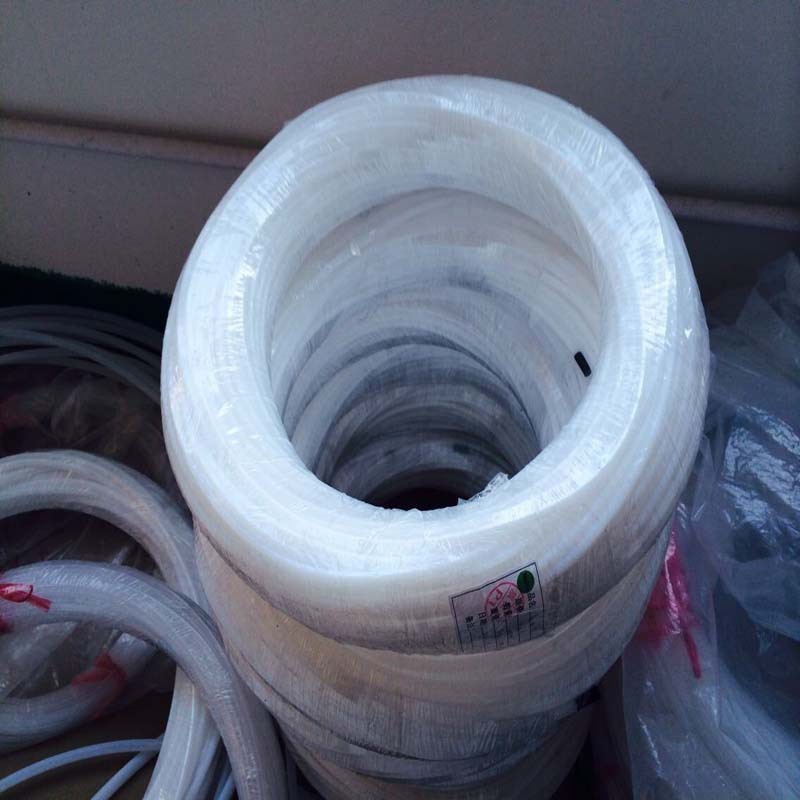
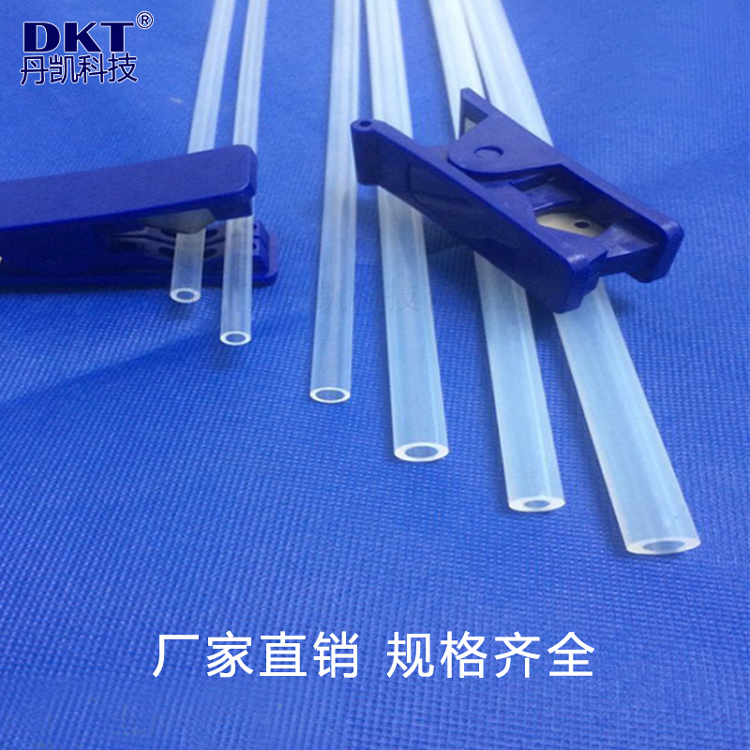
Figure 2: PTFE tube Source: Dankai
Medium: hydrofluoric acid, phosphoric acid, sulfuric acid, nitric acid, hydrochloric acid, various organic acids, organic solvents, strong oxidants and other strong corrosive chemical media.
Temperature -20~250 ℃, allowing quenching and quenching, or alternating operation of cold and heat.
-20 to 250°C (-4 to +482 °F);
Pressure -0.1~6.4Mpa (full negative pressure to 64kgf/cm2);
压力-0.1~6.4Mpa (Full vacuum to 64kgf/cm2);
High temperature resistance-the working temperature can reach 260 ℃.
Low temperature resistance-has good mechanical toughness; even if the temperature drops to -196 ℃, it can maintain a growth rate of 5%.
Corrosion resistance-for most chemicals and solvents, showing inert, strong acid and alkali, water and various organic solvents.
Weather-resistant-has the best aging life in plastics.
High lubrication-is the lowest coefficient of friction in solid materials.
No adhesion-is the smallest surface tension in a solid material and does not adhere to any substance.
Non-toxic-physiologically inert, as a long-term implantation of artificial blood vessels and organs without adverse reactions.

Figure 3: PTFE tube Source: Dankai
The relative molecular mass of polytetrafluoroethylene is relatively large, ranging from hundreds of thousands to over 10 million and generally to millions (the degree of polymerization is in the order of 104, while polyethylene is only in
103). Generally, the crystallinity is 90 ~ 95% and the melting temperature is 327~342 ℃. The CF2 units in the polytetrafluoroethylene molecule are arranged in a sawtooth shape, because the radius of fluorine atoms is larger than that of hydrogen.
Slightly larger, so the adjacent CF2 units cannot be completely cross-oriented in reverse, but form a helical twisted chain, and the fluorine atoms almost cover the surface of the entire polymer chain.
This molecular structure explains the various properties of polytetrafluoroethylene. When the temperature is lower than 19 ℃, a 13/6 helix is formed; a phase transition occurs at 19 ℃, and the molecules are slightly untied to form 15/7
Spiral.
Although the cleavage of carbon-carbon bonds and carbon-fluorine bonds in perfluorocarbons requires the absorption of energy 346.94 and 484.88kJ/mol, respectively, the depolymerization of polytetrafluoroethylene produces 1mol of tetrafluoro
Ethylene requires only an energy 171.38kJ. Therefore, during high temperature cracking, polytetrafluoroethylene is mainly depolymerized to tetrafluoroethylene. Weight loss rate of polytetrafluoroethylene at 260, 370 and 420 ℃
(%) 1 × 10⁻⁴, 4 × 10⁻³ and 9 × 10⁻² per hour, respectively. Visible, PTFE can be used for a long time at 260 ℃. Due to the high temperature cracking also produces highly toxic by-products.
Fluorine phosgene and perfluoroisobutylene, etc., so pay special attention to safety protection and prevent PTFE from contacting open flames.
Mechanical properties: its coefficient of friction is very small, only 1/5 of polyethylene, which is an important feature of perfluorocarbon surface. And because the fluorine-carbon chain intermolecular force is very low, so poly four.
Fluorine fluoride is not sticky. It does not melt at a temperature of 250°C and is not brittle at an ultra-low temperature of -260°C. PTFE is so smooth that even ice can't compare with it.
Edge performance is particularly good, a thick layer of newspaper film, it is enough to resist 1500V high voltage.
Dankai PTFE in -196~260 ℃ wide temperature range to maintain excellent mechanical properties, perfluorocarbon polymer is one of the characteristics of the low temperature is not brittle.
Chemical resistance and weather resistance: except for molten alkali metal, polytetrafluoroethylene is hardly corroded by any chemical agent. For example, in concentrated sulfuric acid, nitric acid, hydrochloric acid, and even in aqua regia
In the boiling, its weight and performance have no change, almost insoluble in all solvents, only slightly soluble in all alkanes (about 0.1g/100g) above 300 ℃. Dankai Polytetrafluoroethylene
The ene does not absorb moisture, does not burn, and is extremely stable to oxygen and ultraviolet rays, so it has excellent weather resistance.
Electrical properties: PTFE in a wide frequency range of dielectric constant and dielectric loss are very low, and the breakdown voltage, volume resistivity and arc resistance are high.
Radiation resistance: The radiation resistance of PTFE is poor (104 rad), which causes degradation after high-energy radiation, and the electrical and mechanical properties of the polymer are significantly reduced.
Polytetrafluoroethylene is produced by radical polymerization of tetrafluoroethylene. Industrial polymerization is carried out in the presence of a large amount of water stirring to disperse the heat of reaction and facilitate
Control temperature. Polymerization is generally carried out at 40~80 ℃,3~26 kgf/cm2 pressure, inorganic persulfate, organic peroxide can be used as initiator, can also be used
Redox Initiation System. The exotherm was 171.38kJ per mole of tetrafluoroethylene polymerized. The dispersion polymerization requires addition of a perfluoro-type surfactant such as perfluorooctanoic acid or a salt thereof.
Application: PTFE can be molded by compression or extrusion; it can also be made into water dispersion for coating, impregnation or fiber. Dankai PTFE in atomic energy,
Aerospace, electronics, electrical, chemical, machinery, instruments, meters, construction, textile, food and other industries are widely used as high and low temperature resistant, corrosion resistant materials, insulating materials, anti sticking
Coating, etc.
Atmospheric aging resistance: radiation resistance and low permeability: long-term exposure to the atmosphere, the surface and performance remain unchanged.
Non-combustibility: limiting oxygen index below 90.
Acid and alkali resistance: insoluble in strong acids, strong alkalis and organic solvents.
Oxidation resistance: can resist the corrosion of strong oxidants.
Acid and alkaline: neutral.
The mechanical properties of polytetrafluoroethylene are relatively soft. It has a very low surface energy.
Polytetrafluoroethylene (F4,PTFE) has a series of excellent performance.
High temperature resistance-long-term use temperature 200~260 degrees,
Low temperature resistance-still soft at -100 degrees;
Corrosion-resistant aqua regia and all organic solvents;
Weather resistance-the best aging life in plastics;
Highly lubricated-with the smallest coefficient of friction in plastics (0.04);
Non-stickiness-having the smallest surface tension in solid materials without adhering to any substance;
Non-toxic-physiologically inert;
Excellent electrical properties, is the ideal C- class insulation material.
Dankai PTFE material, widely used in national defense, atomic energy, petroleum, radio, electrical machinery, chemical industry and other important sectors.
Products: PTFE ethylene bar, pipe material, plate, turning plate. Polytetrafluoroethylene is a polymer of tetrafluoroethylene. The English abbreviation is PTFE. in the late 1930 s.
Now, 40 years into industrial production. The relative molecular mass of polytetrafluoroethylene is relatively large, with a low of hundreds of thousands, a high of more than 10 million, and generally millions (the degree of polymerization is
104 order of magnitude, while polyethylene is only in the 103). Generally, the crystallinity is 90 ~ 95% and the melting temperature is 327~342 ℃.
The CF2 units in the polytetrafluoroethylene molecule are arranged in a sawtooth shape. Since the radius of fluorine atoms is slightly larger than that of hydrogen, the adjacent CF2 units cannot be completely cross-oriented in trans, but are shaped.
As a spiral twisted chain, the fluorine atoms cover almost the entire surface of the polymer chain. This molecular structure explains the various properties of polytetrafluoroethylene. Temperature below 19 ℃
At 19 ℃, the phase transition occurs, and the molecules are slightly unwound to form a 15/7 helix.
This article is originally created by Teflon's little sister. Welcome to pay attention and take you to grow knowledge together!
Key words:
PTFE, performance, with, various, high temperature resistance, corrosion resistance, weather resistance, high lubrication, non-adhesion, non-toxic


Dankai Technology
Address: Area B, 4th Floor, Building 1, North Yongfa Science and Technology Park, Yanchuan North, Chaoyang Road, Songgang Town, Bao'an District, Shenzhen, China
Tel: +86-755-29979617 23127719 23127819
E-mail: dkt@szdankai.com

Focus on us
Copyright©2024 All rights reserved of Shenzhen Dankai Technology Co., Ltd.