PTFE, PFA, FEP, PVDF Fluoroplastic products industry experts

Brief Introduction of Polytetrafluoroethylene Forming Process
Classification:
Industry dynamics
Author:
PFA tube little sister
Source:
Dankai
Release time:
2023-01-06
Visits:
The molding of expanded polytetrafluoroethylene is divided into two stages. In the first stage, PTFE bulk resin is mixed with lubricating aid in a certain proportion. After a certain period of time, the paste is preformed, and then the paste is
The preform extruded into a longitudinal arrangement of fibers is dried to remove additives; the second stage is stretched at high speed at a temperature below the melting point of PTFE, and then at a temperature above the melting point.
The expanded polytetrafluoroethylene products can be obtained by heat setting the semi-finished polytetrafluoroethylene products in the stretched state.
The process flow is as follows:
(1) Mixing polytetrafluoroethylene resin and extrusion aid according to a certain mass ratio, mixed evenly. Selection of dispersion resin, it has good fiber, low cohesion of particles, molecular chain
A small shear action will be arranged along the long axis of the particles, the formation of linear crystals. The addition of an extrusion aid can increase the adhesion between the particles and reduce the adhesion between the resin particles and the resin and.
The friction between the containers improves the processing performance. Extrusion aid usually available petroleum ether, toluene, acetone, kerosene, paraffin, etc.

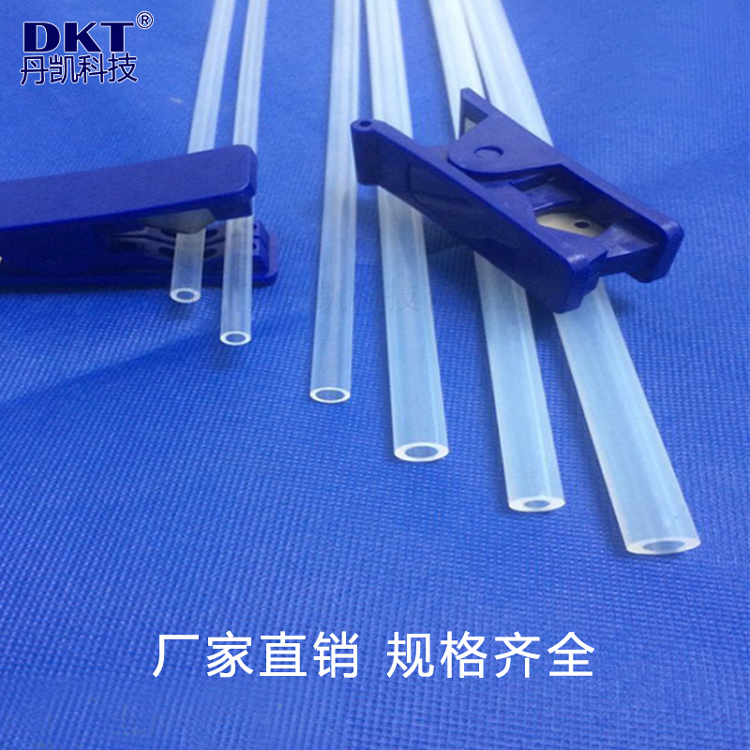
Figure 1: PTFE tube Source: Dankai
(2) Pre-forming The mixture is pressed into a blank with the same shape as the film cavity of the pusher.
(3) Push the blank into the film cavity of the push press to push, and get the bar at the push mouth.
(4) Calendering The bar is calendered with a roller to produce a strip of desired width and thickness.
(5) Drying The strip is heated and dried to remove the extrusion aid on the strip to obtain a polytetrafluoroethylene base film.
(6) The expansion of the PTFE base film is rapidly stretched, and the stretching temperature should be controlled between the glass transition temperature (115 ℃) and the melting point (327 ℃) of the PTFE. Because the polymer chain in
Above the glass temperature has enough vitality, can be pulled away from the irregular group, straighten, and then move each other, when the temperature is higher than the melting point, PTFE.
The particles have melted and become a dense whole, destroying the original fiber bundle folding shape of the particles, and it is difficult to be pulled apart.
(7) Stereotype Place the expanded PTFE base film on the template, then put it into the mold towel, and merge into one by heating and pressurizing. The stereotype process needs to be heated
The melting point (327 ℃) is above, and then the network structure formed after stretching is fixed at a certain temperature and under a certain stress for a period of time. This process needs to be carried out under certain stress.
line, the fiber will shrink during heat treatment. The molding of expanded polytetrafluoroethylene is divided into two stages.

Figure 2: PTFE tube Source: Dankai
In the first stage, Dankai PTFE bulk resin and lubricating additives were mixed in a certain proportion. After a certain period of time, the paste is preformed, and then the paste is extruded into a preformed with longitudinally arranged fibers
The second stage is high-speed stretching at a temperature lower than the melting point of polytetrafluoroethylene, and then the polytetrafluoroethylene in the stretched state at a temperature higher than the melting point.
The semi-finished product is heat-set to obtain the expanded polytetrafluoroethylene product.
The process flow is as follows:
(1) Mixing the Dankai PTFE resin and the extrusion aid according to a certain mass ratio, mixing evenly. Selection of dispersion resin, it has good fiber, low cohesion of particles, points
The sub-chain will be arranged along the long axis of the particle to form a linear crystal. The addition of an extrusion aid can increase the adhesion between particles and reduce the adhesion between resin particles and trees.
The friction between the grease and the container improves the processing performance. Extrusion aid usually available petroleum ether, toluene, acetone, kerosene, paraffin, etc.
(2) Pre-forming The mixture is pressed into a blank with the same shape as the film cavity of the pusher.
(3) Push the blank into the film cavity of the push press to push, and get the bar at the push mouth.
(4) Calendering The bar is calendered with a roller to produce a strip of desired width and thickness.
(5) Drying The strip is heated and dried to remove the extrusion aid on the strip to obtain a polytetrafluoroethylene base film.
(6) Expansion The Dankai PTFE base film is rapidly stretched, and the stretching temperature should be controlled between the glass transition temperature (115 ℃) and the melting point (327 ℃) of the PTFE. Because macromolecule
The chain has enough vitality when it is higher than the glass temperature, so that it can be pulled away from the irregular group, straightened, and then moved to each other, when the temperature is higher than the melting point, polytetrafluoroethylene.
The alkene particles have been melted and become a dense whole, destroying the original fiber bundle folding morphology of the particles, and it is difficult to be pulled apart.
(7) Stereotype Place the expanded PTFE base film on the template, then put it into the mold towel, and merge into one by heating and pressurizing. The stereotype process needs to be heated
The melting point (327 ℃) is above, and then the network structure formed after stretching is fixed at a certain temperature and under a certain stress for a period of time. This process needs to be carried out under certain stress.
line, the fiber will shrink during heat treatment. The molding of expanded polytetrafluoroethylene is divided into two stages. The first stage will be PTFE resin and lubrication additives in a certain proportion.
Mix. Placed for a certain period of time after the pre-molding, and then the paste extruded into a longitudinal arrangement of fiber-shaped preforms by drying to remove additives;
The temperature of high-speed stretching, and then at a temperature higher than the melting point of the stretched PTFE semi-finished products for heat setting, you can get the expansion of PTFE system.
product.

Figure 3: PTFE tube Source: Dankai
The process flow is as follows:
(1) Mixing polytetrafluoroethylene resin and extrusion aid according to a certain mass ratio, mixed evenly. Selection of dispersion resin, it has good fiber, low cohesion of particles, molecular chain
A small shear action will be arranged along the long axis of the particles, the formation of linear crystals. The addition of an extrusion aid can increase the adhesion between the particles and reduce the adhesion between the resin particles and the resin and.
The friction between the containers improves the processing performance. Extrusion aid usually available petroleum ether, toluene, acetone, kerosene, paraffin, etc.
(2) Pre-forming The mixture is pressed into a blank with the same shape as the film cavity of the pusher.
(3) Push the blank into the film cavity of the push press to push, and get the bar at the push mouth.
(4) Calendering The bar is calendered with a roller to produce a strip of desired width and thickness.
(5) Drying The strip is heated and dried to remove the extrusion aid on the strip to obtain a polytetrafluoroethylene base film.
(6) The expansion of the PTFE base film is rapidly stretched, and the stretching temperature should be controlled between the glass transition temperature (115 ℃) and the melting point (327 ℃) of the PTFE. Because the polymer chain in
Above the glass temperature has enough vitality, can be pulled away from the irregular group, straighten, and then move each other, when the temperature is higher than the melting point, PTFE.
The particles have melted and become a dense whole, destroying the original fiber bundle folding shape of the particles, and it is difficult to be pulled apart.
(7) Stereotype Place the expanded PTFE base film on the template, then put it into the mold towel, and merge into one by heating and pressurizing. The stereotype process needs to be heated
The melting point (327 ℃) is above, and then the network structure formed after stretching is fixed at a certain temperature and under a certain stress for a period of time. This process needs to be carried out under certain stress.
line, the fiber will shrink during heat treatment.
This article is originally created by Teflon's little sister. Welcome to pay attention and take you to grow knowledge together!
Key words:
Polytetrafluoroethylene, temperature, certain, resin, stretching, melting point, forming, conducting, granules


Dankai Technology
Address: Area B, 4th Floor, Building 1, North Yongfa Science and Technology Park, Yanchuan North, Chaoyang Road, Songgang Town, Bao'an District, Shenzhen, China
Tel: +86-755-29979617 23127719 23127819
E-mail: dkt@szdankai.com

Focus on us
Copyright©2024 All rights reserved of Shenzhen Dankai Technology Co., Ltd.